With so much happening this year, my photography for this assignment has lapsed. The truth is, I had opportunities but with the universe seemingly a bit out of sorts, I’ve had a lot on my plate and getting to my nearby park became the impossible task. Summer came and went and I knew I’d have to do something last minute over a shorter period of time to submit for this assignment.
I’ve had ideas and opportunities but I wanted to find something that I could feel excited and passionate about rather than going through the motions in order just to submit something. Whilst scrolling through WP reader, a Falmouth MA student had written about the work of Ori Gersht, in particular ‘Blow up’ where the artist freezes flower arrangements in liquid nitrogen then essentially films/photographs them whilst he shatters them.
I like the performance element of this (and yes I did google whether it was possible to buy liquid nitrogen). In another of his works, ‘Fragile Land’, Gersht uses an air rifle to ‘explode’ flowers native to his homeland. He explains that these flowers were once seen as a symbol of the connection between the Jewish people and their homeland. Now near extinction, Gersht uses cultivated specimens.
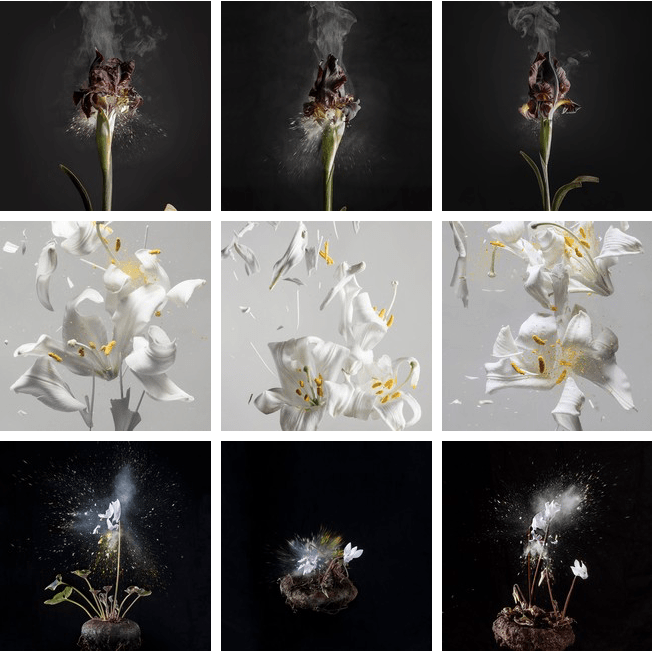
As in his work, ‘Blow up’, there is a question toward the beauty and fragility of the natural world alongside questions of what is enduring and what is momentary, a question which Gersht writes is “a contradiction embedded in the very nature of photography.”(Gersht, 2018)
Thinking about Global warming
With David Attenborough on our screens a lot recently, I found myself thinking about the fragility of our planet and particularly with current events, how quickly things can be taken away and perhaps whether we have the ability to respond to global events. In many ways, Climate change/Global warming is happening whilst we are looking the other way. I came across an article in the New York Times by Nathanial Rich. It documents events during late 70’s/80’s where Climate Scientists were trying to persuade governments that the threat of Global warming was something that needed to be taken seriously.
It’s an interesting read, if not somewhat frustrating. Over the last thirty years there have been Scientific papers, summits and proposals We have come so close to taking action and yet finding consensus on Global action remains elusive. Certainly, my understanding is that what could have been a 1.5 degree rise in temperature is now more likely to be four or even five degree rise in temperature by the end of the century. What this amounts to is a mix of flooding and desertification making large swathes of our land uninhabitable with massive food insecurity.
The images included in this piece are a mix of archival images and more recent video’s/photographs by George Steinmetz. They highlight photography’s unique place in recording moments in time but also showing change which seems pertinent to this assignment. The photography/videos of recent Climate associated events juxtaposed with text and historical images makes this a powerful piece, that show the changes that are occurring, almost a bit depressing.
Melting ice
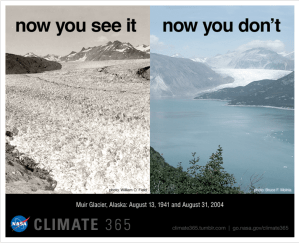
Photography plays an important role within Climate science in it’s ability to document a particular moment and show the changes that occur over time. According to the NASA website, “Forty-six gigatons of ice from Alaskan glaciers was lost on average each year from 2003 to 2010.” There are numerous sources where photography is able to ‘display the evidence’ such as the <a rel=”noreferrer noopener” href=”http://Nationalgeographic.com. 2017. Pictures Show Climate Change’s Dramatic Arctic Impact. [online] Available at: National Geographic magazine featuring Greenpeace photographer Christian Aslund, Tina Freeman’s exhibition ‘Lamentations’ featured in the Smithsonian magazine which juxtaposes melting sea ice with flooding wetlands, Camille Seamans ‘Last Iceberg series, and particularly worthy of mention is the award winning documentary ‘Chasing ice’ which demonstrates sheer grit on the part of the photographer alongside technologies that are able to withstand the harsh conditions in order to document an ever changing dynamic landscape.
Frozen flowers
The next step on this path to creating a piece of work was to take some of Ori Gersht’s concept and plan something that would be manageable with limited resources. I began thinking about melting ice and the idea of freezing flowers in blocks of ice. A google search revealed this has been a popular idea amongst photographers.
Makoto Azuma
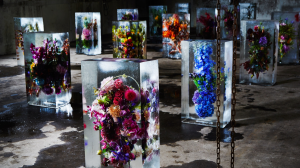
Japanese flower artist Makoto Azuma has taken floristry to new levels. He explains the Japanese term ‘Mono no aware’ which means an attraction to things that fade. He explains: “the transiency of precious things gives way to sadness, but there is also beauty in the realization that we were able to witness those things at all”.
Marisa Culatto
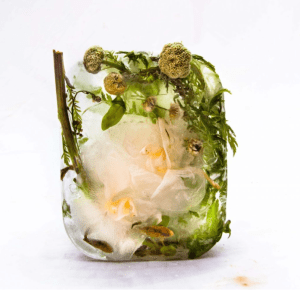
Culatto’s frozen flowers are on a much smaller scale and more ‘natural’ or organic in nature compared to Azumo’s grand floral arrangements. Culatto explores the fragility of beauty and how we try to hold on to it but inevitably it fades. As Culatto staes: “in the end this speaks of the very act of photography: to freeze the moment”.
Bruce Boyd
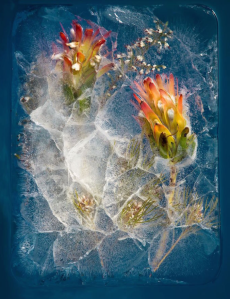
In a similar vein, Boyd freezes flowers then tosses them into puddles or a swimming pool which causes the ice to crack creating beautiful effects.
References
Gersht, O., 2018. [online] Origersht.com. Available at: <https://www.origersht.com/copy-of-fragile-land-2018-1> [Accessed 20 October 2020].
Rich, N., 2018. Losing Earth: The Decade We Almost Stopped Climate Change (Published 2018). [online] Nytimes.com. Available at: <https://www.nytimes.com/interactive/2018/08/01/magazine/climate-change-losing-earth.html> [Accessed 20 October 2020].
My Modern Met. 2016. Photos Of Frozen Flowers Capture The Paradoxical Beauty Of Preservation And Destruction. [online] Available at: <https://mymodernmet.com/zero-degrees-frozen-flowers/> [Accessed 24 October 2020].
Mazurek, B., 2017. Celebrate Valentine’S Day By Checking Out The World’S Most Insane Florist. [online] GQ. Available at: <https://www.gq.com/story/the-man-who-launched-a-bonsai-into-space> [Accessed 24 October 2020].
Marisaculatto.com. 2020. Flora – Marisa Culatto. [online] Available at: <https://marisaculatto.com/work/flora/> [Accessed 24 October 2020].
Nationalgeographic.com. 2017. Pictures Show Climate Change’s Dramatic Arctic Impact. [online] Available at: <https://www.nationalgeographic.com/news/2017/03/my-climate-action-q-a-aslund-arctic-glacier-greenpeace/> [Accessed 26 October 2020].
Lallensack, R., 2019. Paired Images Of Melting Glaciers And Flooding Wetlands Tell The Story Of Global Climate Change. [online] Smithsonian Magazine. Available at: <https://www.smithsonianmag.com/travel/paired-images-melting-glaciers-flooding-wetlands-tell-story-global-climate-change-180973609/> [Accessed 26 October 2020].
Camille Seaman PHOTOGRAPHY. 2020. LAST ICEBERG SERIES III — Camille Seaman PHOTOGRAPHY. [online] Available at: <https://www.camilleseaman.com/photographs/lasticebergseries3> [Accessed 26 October 2020].
Chasingice.com. 2020. Chasing Ice | The Award-Winning Documentary On Climate Change. [online] Available at: <https://chasingice.com> [Accessed 26 October 2020].
 Landscape, Place and Environment
Freezing flowers is a great topic to investigate. Not as easy as it looks. Good luck, I’m sure you’ll make it look amazing.
LikeLike
I’ve done a few already & currently shooting ‘the one’ that I think will be be my submission. Fascinating watching it melt lol
LikeLike
Fantastic! I was thinking about whether you could reverse the video / images so it looks like it is freezing as opposed to melting. Something to play around with. 🙂
LikeLike