Introduction
English national identity is deeply rooted in the British landscape. Is what we encounter a patriotic national pride, grounded by our links to the past or is it an overt stubborn nationalism from a warring island nation divided by class? The aim of this text is to explore Photography’s contributions in understanding our national identity within the context of it’s links to our landscape.
Constable Country
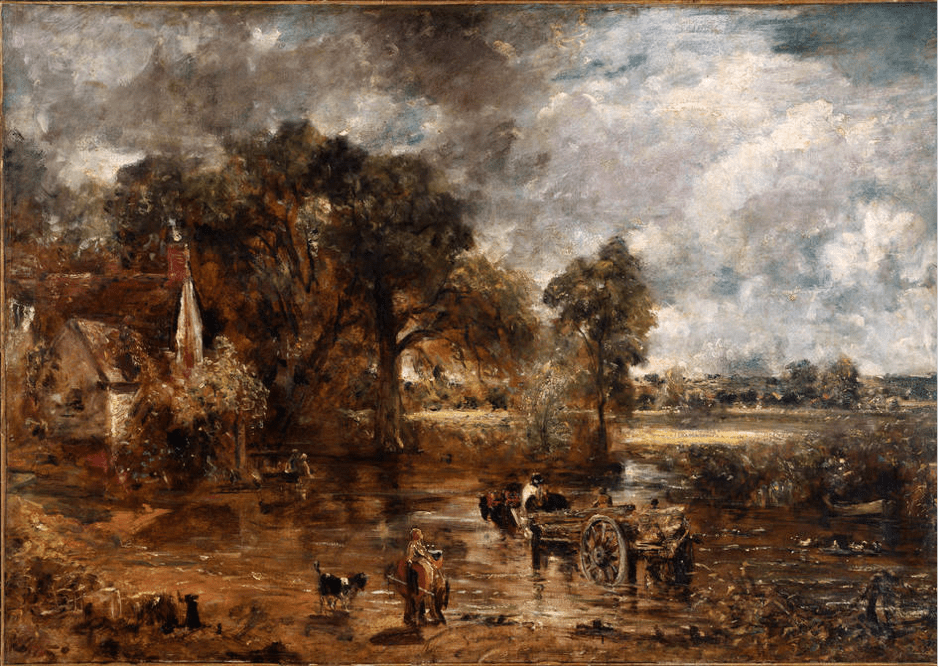
It is widely accepted that the genre of British Landscape photography has it’s origins in the pictorial traditions of 19th century Landscape painting. Reviewers of English landscape painter John Constable at the time celebrated his bold and vigorous handling of the paint and his depiction of the light rather than challenging the realities of the“economic hardship and discontent”. (Alexander, 2015 pg 66) The Haywain scene is not entirely truthful, either in it’s physical representation of the landscape or as commentary on rural life but represents a romantic idyll, popular at the time which emboldened the myth of the simplicity and beauty of rural life.
This illusion of the romantic idyll still pervades in the collective consciousness but goes back further and deeper than 19th Century romantic art. Stonehenge, the ruins of Tintagel, Hadrians wall and smugglers caves are but a few of the examples of how our landscape consolidates the mythologies of the past with stories of heroes and conquests which take place in a Tolkien-esque realm.
The very heart and soul of ‘What is England?’ resides in the rural landscape rather than the modern city. (Rosenthal, 2006 pg 40) As the industrial revolution was gathering pace, Britain was clinging to this ‘old-England’ with it’s mythic traditions, craving continuity and preservation. In a desire to stop the growing urbanisation of Britain, The National Trust was founded in 1894, the aim was to preserve natural beauty and heritage for the nation. It could be argued that ownership of land and the representations of it were being controlled by the landed gentry and that, the Lake District for example, as a community of farms, whilst preserved, has been denied it’s natural evolution and is now becoming a theme-park for tourists.
In her images of the Lake District, Ingrid Pollard challenges this notion of ‘for the nation’ and consequently Britain’s colonial past. She confronts the position of the white masculine ‘hero’ who conquers the dark spaces (Taylor, 1994 pg 275) which in many respects is a theme of Burke and Kant’s sublime and both Britains military and colonial past. In Pastoral Interlude 1988, Pollard represents the binary distinction of the rural that is ostensibly white, affluent, middle class and the urban spaces that are multi-cultural, chaotic and poor. In Wordsworth’s Heritage 1992, she wanders ‘lonely as a black face in a sea of white’. (Taylor, 1994 pg 275)
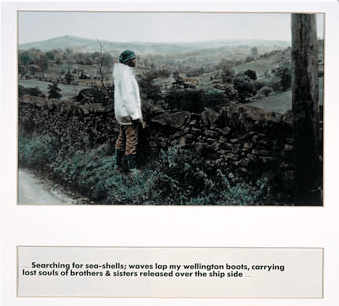
Pollard’s work is a good example of how photography can challenge the notion of our airbrushed heritage. Heritage itself invites suspicion, on the premise that history is written by the victors. War and empire building comes of course at the expense of the poor, lower class and disadvantaged, however the narratives celebrate this sacrifice for the good of the nation and symbolises strength and power, something which becomes starkly evident during the Second World war.
Something to fight for
By the Second World war, photography had positioned itself within the world of art exploring it’s potential to embrace social change and it’s locus in the world of fashion and photo-journalism. (Tate, 2020) As parts of Europe fell to the Nazi’s, the very land of ‘England’ was under threat. Whilst photography had a role in reporting the horrors of war it also served to reconnect the nation with the land that was worth fighting for.
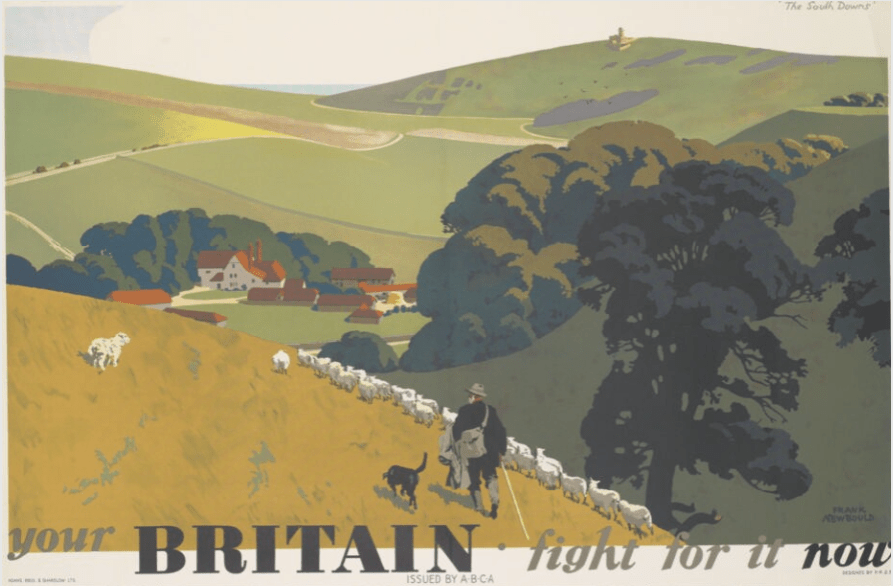
The controlled narratives of the photographic images used during wartime propaganda such as Frank Newbould’s poster’s (Alexander, 2015. pg 146) and ‘Meet the Common People’ by Edward Carrick and Gerry Bradley 1943 (Taylor, 1994 pg 187) called upon the ‘romanticism and naturalness’ of Britain’s landscape, creating a sense of unity, common purpose and a “gentle patriotism”. (Taylor, 1994 pg 188) This view of England and Englishness was in stark contrast to the German way of life which was presented as mechanical, militarised and restricted. The beauty of the British landscape became the rallying cry for the freedoms of the common British people.
But was and is, Britain really a land for the ‘common’ people? Fay Godwin’s ‘Our Forbidden Land’ was published as Godwin’s response to what she saw as oppressive agencies who blocked public access to land particularly for ramblers. Her images are accompanied by text which often describe the arguments she had with farmers and landowners. (Taylor, 1994 pg 276) Godwin’s work contributed to the ‘right to roam’ movement launched by the Rambler’s association in 1985 which eventually resulted in “the Countryside and Rights of Way Act (known as CRoW)” in 2000. (Ramblers, 2020)
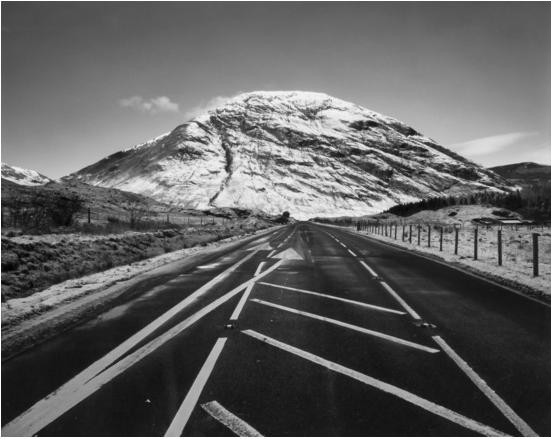
As well as fighting for access, Godwin challenges our notions of the picturesque and highlights the rural-urban divide. She describes the picturesque as “very soft, warm blankets of sentiment”. (Alexander, 2015. pg 64) Her concern, and rightly so, was the lack of understanding of the complexities of rural life and how the ‘countryside’ had become a destination for leisure activities. The land becomes a neatly packaged commodity with ‘facilities’ for tourists which unbalances the rural economy and creates a landscape which is managed and marketed.
Patriotism or Nationalism?
The White cliffs of Dover, now being acquired by the National Trust, are regarded as an iconic symbol of Britain. References to the Cliffs can be found as far back as Julius Caesar and became a popular landscape subject in 19th Century, painted by Turner for example as an ideal of the picturesque. More than it’s associations with the picturesque, the Cliffs contributed to the conceptualisation of Britain as an island nation. (Readman, 2018. pg 32) This insularity was also a symbol of Britain’s defence. The Cliffs had certainly functioned that way and had been fortified for hundred’s of years in various wars with European Countries.
The Cliffs also had a sentimental symbolism with ‘home’. It would be the first thing that those travelling whether during wartime or through leisure would see. It has become representative of safety and security, and it’s no wonder that there were those opposed to the building of the channel tunnel. It meant our fortifications could be penetrated and Britain was no longer an island.
That fear of invasion and the retention of Britain as an independent sovereign nation, really came to the fore during the Brexit debate. The right-wing group Britain First highjacked the symbolism of the White Cliffs of Dover and the rhetoric of the Second World War and manipulated it into a nationalistic rallying cry for the leave campaign under the guise of patriotism, which of course presents a confusing irony.
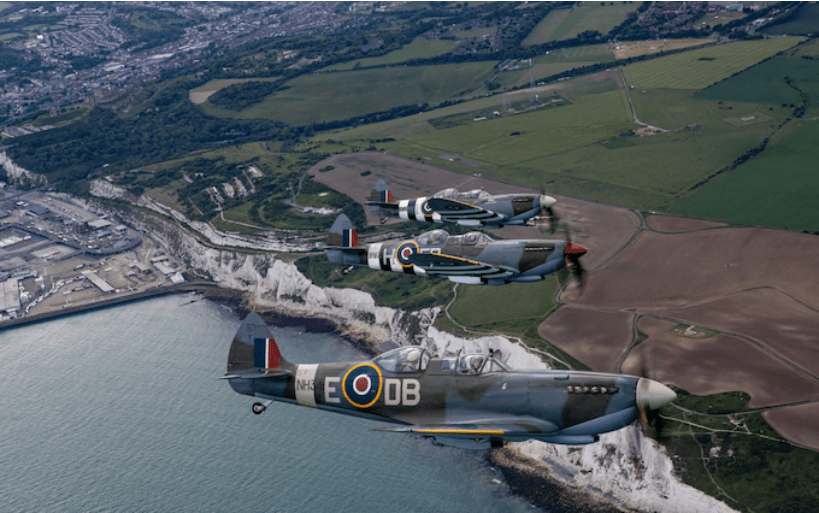
This image of the Cliffs, is from an article in the Telegraph of the recent VE day commemoration which was hampered by the Coronavirus lockdown. The article references the Vera Lynn song from 1942, ‘The White Cliffs of Dover’ which promises a “peaceful and bucolic future” once war is over:“the shepherd will tend his sheep, the valley will bloom again…” (Hall et al., 2020) So powerful is this imagery, that when crisis strikes, it becomes a comforting reference point for the nation.
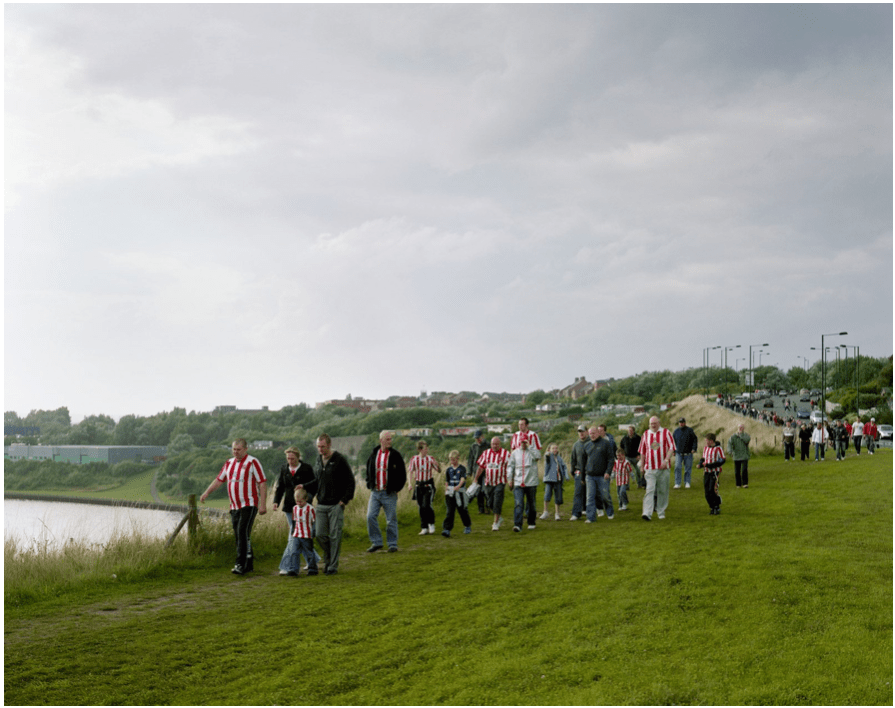
“We English” is a piece of work by Simon Roberts. He asked the public to suggest locations and events for him to photograph. “This produced over 800 posts of ideas from the public which included many scenes that could be regarded as “Constable picturesque” or Turner-esque but mainly relating to history and childhood memory”. (Roberts, 2020) The image here is a deliberate inclusion because of the football shirts, a typical symbol of English tribalism. Many of the images are clever depictions of the British public at leisure in often picturesque landscapes. Fields, seasides, stately homes, boating, all symbols that tie in with a sense of Englishness.
The images represent a sense of what Michael Billig describes as ‘Banal Nationalism’ relating to ‘forgotten remembrance’ which refers to this unconscious act of ‘flagging’ in the sense of these discreet symbols of nationhood that are all around us. (Roberts, 2020) Whilst the image of the football shirts may at first glance seem nationalistic, evoking recollections of aggressive football hooligans, looking at the scene more closely, what we see is a convivial family day out. What Chambefort-Kay points out, is that Roberts’ images in general present a very genuinely relaxed atmosphere. The people here are collectively going about their leisure and therefore the project goes beyond ideological notions of patriotism and nationalism but a more complex model of social cohesion. This may seem a surprising conclusion especially as the project is titled “We English” and full of symbols of ‘little englishness’.
Conclusion
Exploring this topic has given me a broader view of depictions of the British landscape and how they are used in reference to our understanding of ‘who we are’ as a country. English identity is closely related to it’s Landscape in terms of national pride and belonging. We must also consider race and gender, which are no longer issues that represent a simple binary choice. Neither is the distinction between urban and rural or what once may have been regarded as a simple ‘upstairs-downstairs’ division of class. Photography has played a part in helping us understand these complexities.
The relationship between all these factors is a result of many layers of history, myth and visual imagery passed down through generations. It is something which is evolving and changing slowly through time but our connection to landscape also helps us to retain an element of permanence and certainty. What seems evident, is that whilst there is a general collective narrative which a majority might be comfortable with, and is suggestive in the main of a semblance of a level of social unity and cohesion, it doesn’t work for everyone.
It’s interesting to look at a BBC survey in 2018 that suggested the English identity was bound to the natural landscape and our past history. The survey suggests, “The strongest image of England is a pre-industrial bucolic nation populated by well-mannered and virtuous citizens.” which takes us right back to Constable, the picturesque and the rural idyll. Maybe it is an idyll that collectively we are simply comfortable with.
During the Brexit referendum, I read commentaries on Britain being a nation at war with itself. War and the defence of ‘our island’ has been a big part of our history. We are fond of our castles and the stories of our past military victories. Despite a desire for autonomy and sovereignty, we celebrate ‘strong leadership’ someone to look up to and govern, particularly in times of crisis.
Moving forward there are new issues such as Climate change to explore. There is a shift in perception as to how Land should be managed if in fact we should be looking to ‘manage’ it at all. My impression of the National Trust for example is that they are moving towards a more ecological standpoint rather than preservation of heritage in the sense of stately homes and grand histories. Perhaps this represents a changing perception of our relationship with the Landscape. There is no one single representation of what and who is England however it seems our Landscape remains both a divisive and unifying factor.
Bibliography
- Alexander, J., 2015. Perspectives On Place. Bloomsbury Publishing.
- Andrews, M., 1999. Landscape And Western Art. Oxford Paperbacks.
- BBC News. 2020. The English Question: What Is The Nation’s Identity?. [online] Available at: <https://www.bbc.co.uk/news/uk-44306737> [Accessed 2 June 2020].
- Matless, D., 2016. Landscape And Englishness. 2nd ed. Reaktion Books Ltd.
- Pollard, I., 2020. Pastoral Interlude. [online] ingrid pollard photography. Available at: <http://www.ingridpollard.com/pastoral-interlude.html> [Accessed 22 May 2020].
- Readman, P., 2018. Storied Ground. Cambridge University Press.
- Roberts, S., 2020. We English – Simon Roberts. [online] Simon Roberts. Available at: <https://www.simoncroberts.com/work/we-english/> [Accessed 23 May 2020].
- Rosenthal, M. 2006. Constable and Englishness. The British Art Journal, 7(3), 40-45. Retrieved May 22, 2020, from www.jstor.org/stable/41614716
- Tate. 2020. A-Z Of Modernist Photography | Tate. [online] Available at: <https://www.tate.org.uk/art/art-terms/p/photography/a-z> [Accessed 22 May 2020].
- Taylor, J., 1994. A Dream Of England. Manchester [England]: Manchester University Press.
- National Trust. 2020. Who Was Hardwicke Drummond Rawnsley?. [online] Available at: <https://www.nationaltrust.org.uk/features/who-was-hardwicke-drummond-rawnsley> [Accessed 23 May 2020].
Images
Victoria and Albert Museum. 2020. V&A · John Constable – An Introduction. [online] Available at: <https://www.vam.ac.uk/articles/john-constable-an-introduction> [Accessed 22 May 2020].
Pollard, I., 2020. Pastoral Interlude. [online] ingrid pollard photography. Available at: <http://www.ingridpollard.com/pastoral-interlude.html> [Accessed 22 May 2020].
Imperial War Museums. 2020. Your Britain – Fight For It Now [South Downs]. [online] Available at: <https://www.iwm.org.uk/collections/item/object/20289> [Accessed 23 May 2020].
Artnet.com. 2020. Meall Moir Glencoe From Our Forbidden Land Series By Faygodwin. [online] Available at: <http://www.artnet.com/artists/fay-godwin/meall-moir-glencoe-from-our-forbidden-land-series-gRe2SQw3bn5tLELMZSnV9A2> [Accessed 31 May 2020].
Hall, et al 2020. How Vera Lynn’s The White Cliffs Of Dover Mended Britain’s Broken Heart. [online] The Telegraph. Available at: <https://www.telegraph.co.uk/music/artists/vera-lynns-white-cliffs-dover-mended-britains-broken-heart/> [Accessed 31 May 2020].
Roberts, S., 2020. We English – Simon Roberts. [online] Simon Roberts. Available at: <https://www.simoncroberts.com/work/we-english/> [Accessed 23 May 2020].
 Landscape, Place and Environment