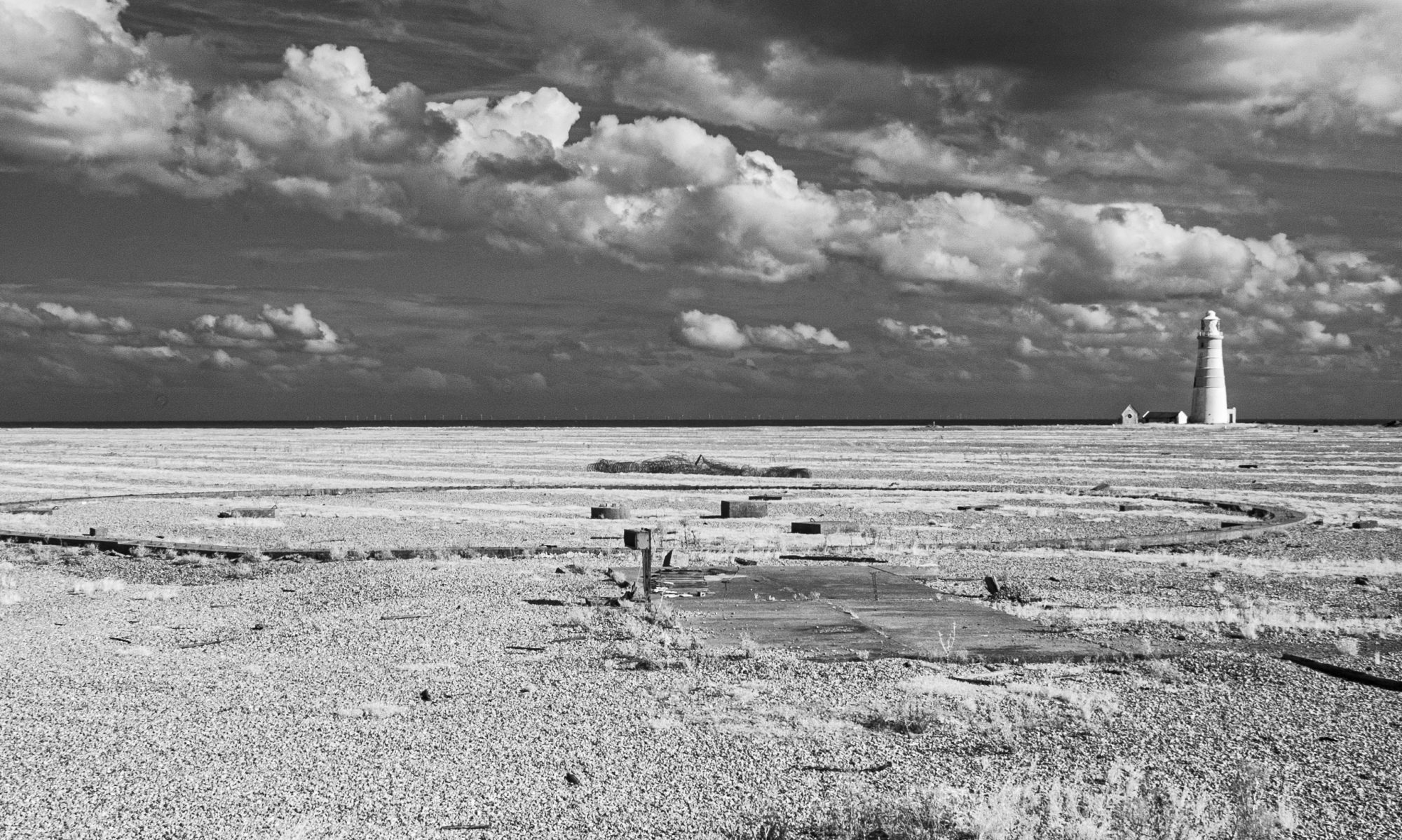
The Naze is a mix of human-made and human-altered landscape and a natural and nature-altered Landscape. In many ways it is not entirely one or the other. It’s most distant history (65 million years ago) is shaped by Climatic evolution and the shifting of tectonic plates that literally altered the geographical location (in terms of latitude and longitude) of the area. It’s more recent history, (two thousand years), is shaped by humans, from Viking settlers who farmed the land, to the creation of the neighbouring Victorian seaside resort, Walton on the Naze, to an effort to prevent coastal erosion by the erection of various sea walls and groins, the creation of a Wildlife conservation area to it’s current state as a visitors centre, a place to walk and particularly a place to hunt fossils and learn about it’s specific geology.
For scientists, The Naze is of special importance in understanding past Climate events which may be the key to predicting the future of our planet. By collecting fossils but also samples of pollen and fragments of fossilised plant material for example, a picture of the Climate processes in what we can call ‘deep time’, 4,500 million years ago, can be built. What scientists have gleaned over the years, not just from the Naze, is that the Earth has gone through five major extinction events. These have coincided with extreme Climatic change.
“This period in Earth’s past was characterised by high variation in sea levels, and rapidly alternating conditions of global cooling and warming.”
(Frederik Saltre, Corey J. A. Bradshaw, 2019)
This is a huge area of research and one that, as much as I’m interested in, isn’t relevant to go into vast amounts of detail for the purposes of this assignment. What is relevant to understand is that our current climate, which is agreeable to humans is one that slowly moves from ice age to warming. Climate change deniers will say that our current changes are all natural. Particularly in the the last 50 years, through the burning of fossil fuels, we have released an enormous amount of CO2 into our atmosphere which risks unbalancing and vastly accelerating the natural warming process.
Scientists such as James Lovelock (Ages of Gaia) argue that the Earth cannot compensate for this state quickly enough and so what we risk is another mass extinction event. This time us. The planet’s climate is likely to become unstable, leading to an increase in extreme weather events particularly heat waves and flooding. Sea levels could rise more quickly than we can adapt to, potentially we loose all sea life and some areas of the planet will become so warm that they are reduced to desert.
I’ve long been a fan of Lovelock. Even though as a scientist working for Nasa, his original theories were discounted as ‘hippy nonsense’ by the scientific community, now his theories are well established. Sadly Lovelocks view is that we have past the ‘tipping point’, the point of no return. Our demise is already set in motion. My own view, is that I see human ignorance and stupidity but also resilience and resourcefulness. We might save ourselves yet.
What we see at the Naze is accelerating cliff erosion. This is in part due to the soft nature of the Red Crag but mainly due to rising sea levels. Attempts have been made in the past to ‘hold back the sea’ using sea walls, groins in the sand to minimise the shift due to the tides. Now, those efforts are seen as pointless and the local council instead has directed resources in protecting the nearby seaside resorts. It’s likely over the next 50 years, the shape of the coastline will be vastly different.
Edward Burtynsky – Anthropocene
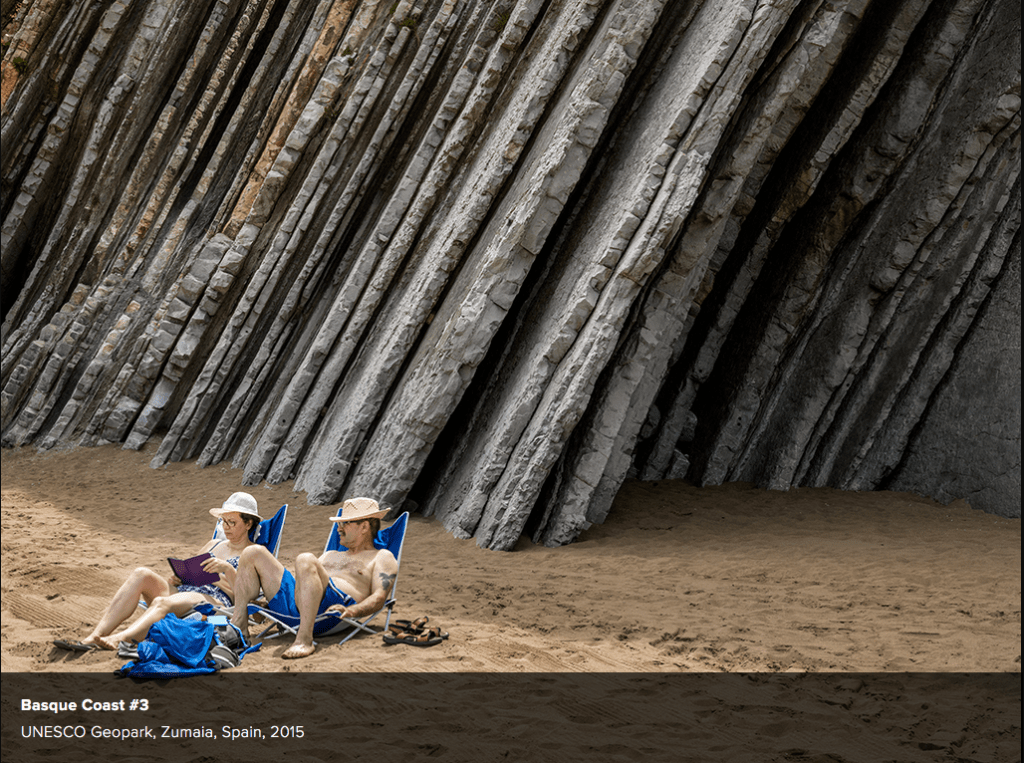
I was excited to come across this project as it reflected to some extent my feelings towards assignment three. Burtynsky presents some stunning images of natural formations alongside human interventions. Some of the human interventions such as the mining and the particularly the plastic mountain seem quite grotesque.
There is a certain beauty though to the human structures that Burtynsky has photographed which often ape the formations and patterns of nature however they also represent a state of over population, pollution and a situation which is unsustainable. In particular, Burtynsky references ‘deep time’ and the geological formation of our plant. I chose the image above as I found a certain irony in the sunbathers with their backs to this stunning natural rock formation and the fact that this was a ‘geo-park’, something that seems to relate to human arrogance.
Looking at the presence of human beings in his photos has influenced my decision to probably include people in my work for assignment three. Originally, I’d thought to focus solely on the Landscape itself but particularly because the brief is about Space and Place, I want to explore the human relationship with a Place.
Geo-asthetics
I came across the term ‘Geo-asthetics’, essentially photographs of geological formations. I decided to look at images of geology but also patterns and textures within nature.
Ingrid Pollard – Landscape Trauma
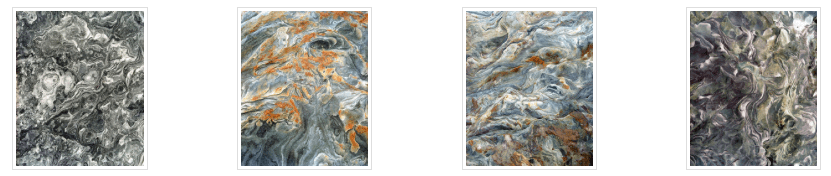
Pollard explores the “illusory nature of photography” by focussing on the elements of the Earth that make up photographic production. The images were presented as large-scale canvases. There is something about these images that makes you want to run your hand over them to feel the texture of the rock.
Richard Woldendorp – Abstract Earth
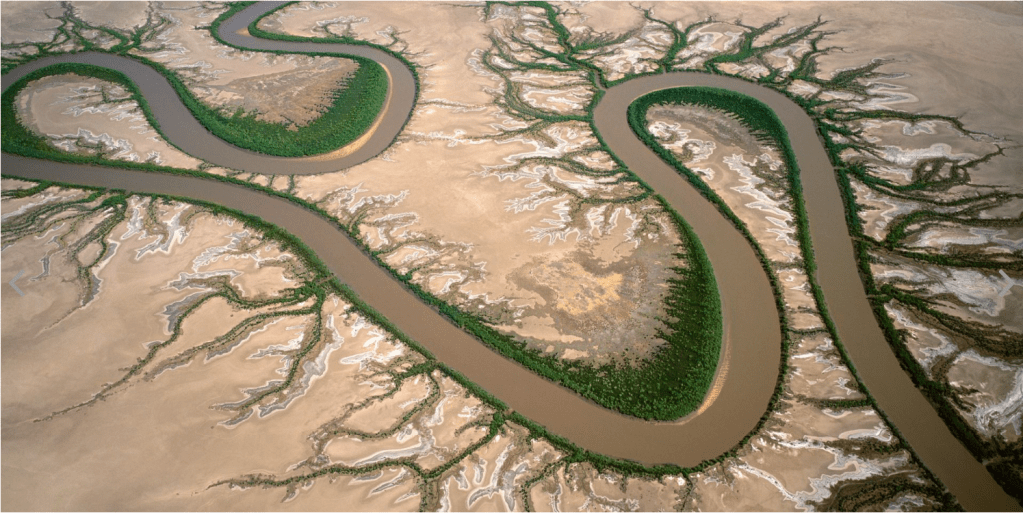
These images are aerial photos of Australia. Woldendorp expresses how taking the photos has heightened his appreciation of the diversity of the Australian landscape. Whilst the images appear abstract, they are real photos of the earth. What he presents are these wonderful patterns that occur in nature.
Richard Long – The Tide is High
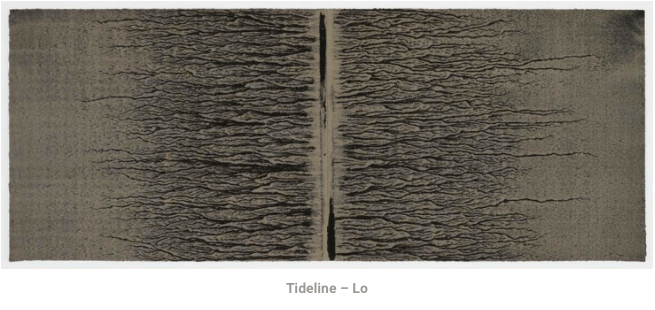
Richard Long used the mud from the River Avon to create these textural pieces. The pattern produced, for me resembles our vascular system which is often what rivers and it’s contributories can look like especially when viewed from above.
References and Bibliography
- Burtynsky, E., 2020. Photographs: Anthropocene — Edward Burtynsky. [online] Edward Burtynsky. Available at: <https://www.edwardburtynsky.com/projects/photographs/anthropocene> [Accessed 22 June 2020].
- Chaundy, B., 2018. Richard Long – The Tide Is High. [online] Considering Art. Available at: <https://consideringart.com/2018/11/21/richard-long-the-tide-is-high/> [Accessed 16 June 2020].
- Hay, W., DeConto, R. & Wold, C. Climate: Is the past the key to the future?. Geol Rundsch 86, 471–491 (1997). https://doi.org/10.1007/s005310050155
- Eerola, T., 2008. [online] Progeo.ngo. Available at: <http://www.progeo.ngo/downloads/PROGEO_news_2008_1.pdf> [Accessed 22 June 2020].
- Frederik Saltre, Corey J. A. Bradshaw, T., 2019. Are We Really In A 6Th Mass Extinction? Here’s The Science. [online] ScienceAlert. Available at: <https://www.sciencealert.com/here-s-how-biodiversity-experts-recognise-that-we-re-midst-a-mass-extinction> [Accessed 22 June 2020].
- Lovelock, J., 1989. The Ages Of Gaia. Oxford: Oxford University Press.
- Pollard, I., 2012. Landscape Trauma. [online] ingrid pollard photography. Available at: <http://www.ingridpollard.com/landscape-trauma.html> [Accessed 22 June 2020].
- Woldendorp, R., n.d. Abstract Earth – Photographs And Text By Richard Woldendorp | Lensculture. [online] LensCulture. Available at: <https://www.lensculture.com/articles/richard-woldendorp-abstract-earth#slideshow> [Accessed 22 June 2020].
 Landscape, Place and Environment