Whilst Martin Parr would be described as a documentary photographer rather than a landscape photographer, his work is pertinent to my assignment four essay because of his focus on British identity. I don’t think there is any other photographer who has contributed so widely, providing both a mirror and a window on what it means to be British.
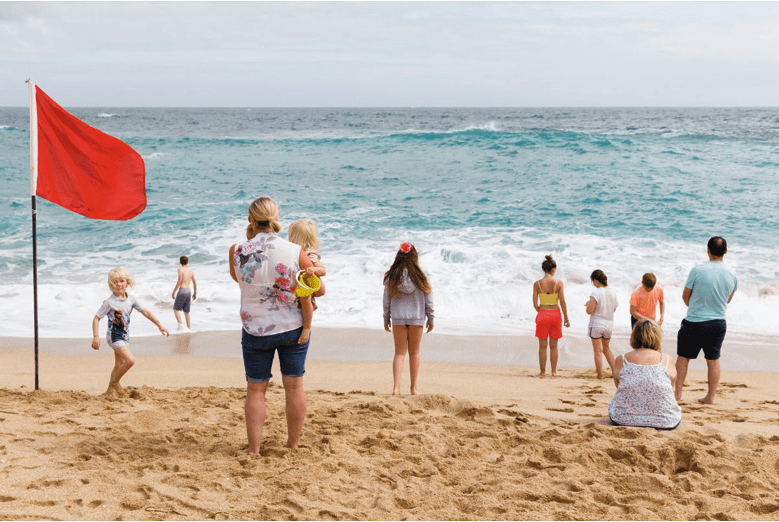
The image above was taken after the referendum. Whilst it’s a classic and seemingly innocent shot of families at the seaside, it suggests the white British fear of immigration as the subjects in the image look out to sea in fear of a coming invasion.
In ‘The Last Resort’, Parr photographs ‘ordinary folk’ at Blackpool beach. There’s a comic element to these images as the Brits gorge on chips and ketchup or stiffly sit in cafe’s which nod to a bygone era. Or, sunbathers lying on grotty pieces of tarmac whilst the small kids run amuck. Of course what we mean by ‘ordinary folk’ is the working class and there are slight feelings of discomfort in viewing these images wondering if Parr is making fun.
In contrast, ‘The Cost of Living’ is centred around ‘the comfortably off’, those that have done alright out of the Thatcher years. These are the ‘middle classes’. In his book ‘A dream of England’ Taylor writes about how this and works by other artists such as Karen Knorr, look at exclusivity, in particular towards our heritage. Taylor writes how our heritage is not made up of a disparate mix of artefacts but rather exists as a representation of the upper classes in the form of great houses, ancient landscape gardens and representations of the gentry and aristocracy. (Taylor, 1994)
‘Think of England’ is a more recent piece of work produced in the 1990’s. The images focus on icon’s of Englishness such as sandals with socks, cricket on the green, afternoon tea with scones and jam, deckchairs and union jacks, top hats at the races and lager! It represents the British/English fondness with nostalgia.
Twenty years on and after a tumultuous time of political and social upheaval in Britain following Brexit, Parr’s latest exhibition “Only Human’ seems to have a softer view on the British public. The flags are still present, so to is the nostalgia and the class divide but there are representations of the multicultural Britain that is beginning to spill into the suburbs rather than just in the city. There are representations of a greater diversity than in Parr’s earlier work and it feels like the lines are softening.
Bibliography
- Martinparr.co.uk. 2020. Martin Parr, The Cost Of Living, Rocket Gallery, London. [online] Available at: <http://www.martinparr.co.uk/cost.htm> [Accessed 17 May 2020].
- Pound, C., 2020. Martin Parr’S Photos Ask What It Means To Be British In The Brexit Era. [online] Artsy. Available at: <https://www.artsy.net/article/artsy-editorial-martin-parr-captured-britishness-brexit-era> [Accessed 17 May 2020].
- Taylor, J., 1994. A Dream Of England. Manchester [England]: Manchester University Press.
 Landscape, Place and Environment