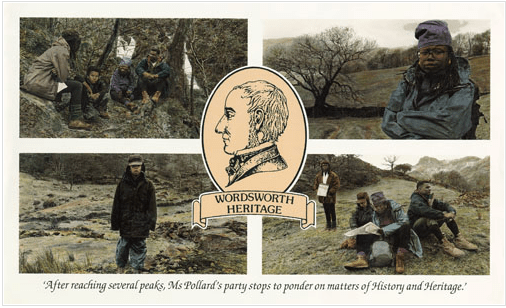
Ingrid Pollard is a London based British artist and photographer who uses portraiture and traditional landscape imagery to explore constructs such as Britishess. (Tate, 2020) I chose to post the image above because it made me smile. Everything about the ‘postcard’ is typical, even the text at the bottom has that typical overly polite, slightly reserved tone that you would associate with the Wordsworth period.
The images are typical tourist images taken probably in and around Grassmere. I know it well, I’m a regular and probably know it better than my currant locale. I’m really drawn to the image top right which I presume is Ingrid herself. She looks cold which is what makes me smile. The truth is that it was unusual to see faces of colour in the Lake district around this time, nearly 30 years ago. That’s changing now but you are more likely to see white faces up in the hills whilst the lowland tourist spots have much more diversity these days.
My reaction to this image is actually I want to join the group and say “Hey, I have a flask of hot tea, come with me I’ll show a great view from the top!”. That reaction says it all really. The truth is, I do associate diversity with the city.
Created in 1988, Pastoral Interlude is a piece of work that I’d like to look at specifically for my essay. Pollard places herself within the typical British Landscape. The images themselves look like album snaps, maybe polaroids, they could be personal holiday images. However Pollard teams the images with text that voice her reaction to standing in that landscape.
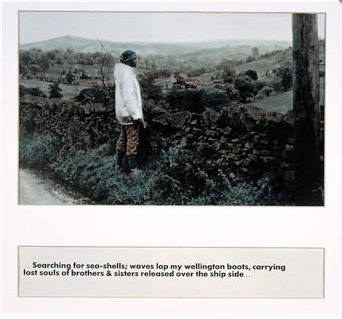
The text is extremely sobering. Whilst Britain celebrates itself as an embracing, multi-cultural country, it is built (and still rests on) the labour and lives of slavery. Pollard challenges the ideas of identity and particularly ownership. The National Trust own this land. It is great thing to know that it can’t be developed however it is still managed and those that make the decisions on how it is managed will tend to be what we consider ‘the ruling class’.
Ownership of land, commerce, economic development, and English involvement in the Atlantic slave trade are elements in this work that look at the construction of the Romantic countryside idyll.
(Pollard, 2020)
Bibliography
- ingrid pollard photography. 2020. Ingrid Pollard Photography. [online] Available at: <http://www.ingridpollard.com> [Accessed 15 May 2020].
- Tate. 2020. Ingrid Pollard Born 1953 | Tate. [online] Available at: <https://www.tate.org.uk/art/artists/ingrid-pollard-15859> [Accessed 15 May 2020].
 Landscape, Place and Environment