Bates begins the essay by stating photography’s negative relationship to memory in the sense that what is missing or not seen within a photograph. This seems to relate to the ‘truth’ of a photograph and how an image might be ‘read’. He also goes on to state photography as a mnemonic device and it’s specific contribution for both Historians and Photographers.
Bates quotes Freud’s views on the mnemonic apparatus that exist to assist memory. These apparatus are extensions of our senses. This can be the written or recorded word and of course the visual, a photograph or film. Freud makes the distinction between ‘Natural memory’ which is open to distortion and failure and ‘Artificial memory’ which could be viewed as more accurate.
Bates refers to Derrida (Archive fever 1995) who questions how do these artificial and technological apparatus affect the psychic apparatus, in other words how do these external technologies change our internal mental space?
In the 1930’s both Walter Benjamin and Siegfried Kraucauer discuss the significance of mechanical visual reproduction and it’s relation to historiography, that photography and film have history as it’s narrative.
Collective memory
Prior to the invention of photography, writing and printing, the production of coins and medals all combine to an act of historical remembering. A common saying is that ‘History is written by the victors’ and so what is passed down as collective memory is also probably ‘selective memory’.
By the eighteenth century, we saw the advent of vast public librarys and public records.
This is a strange area, Le Goff says, “in which politics, sensibilities and folklore mingle . . .” (87). The nineteenth century issues in a whole new era of the industrialization of public memory as “commemoration”.
(Tandfonline.com. 2020)
This of course coincided with the invention of photography which brought a kind of ‘precision and truth’ to public record.
As photography became more accessible, we see the emergence of the family archive. Below is an image I recently acquired which is of my Grandmother and Great-Grandmother obviously taken by a portrait photographer. It connects me with my past although I know very little about my Grandmothers family.
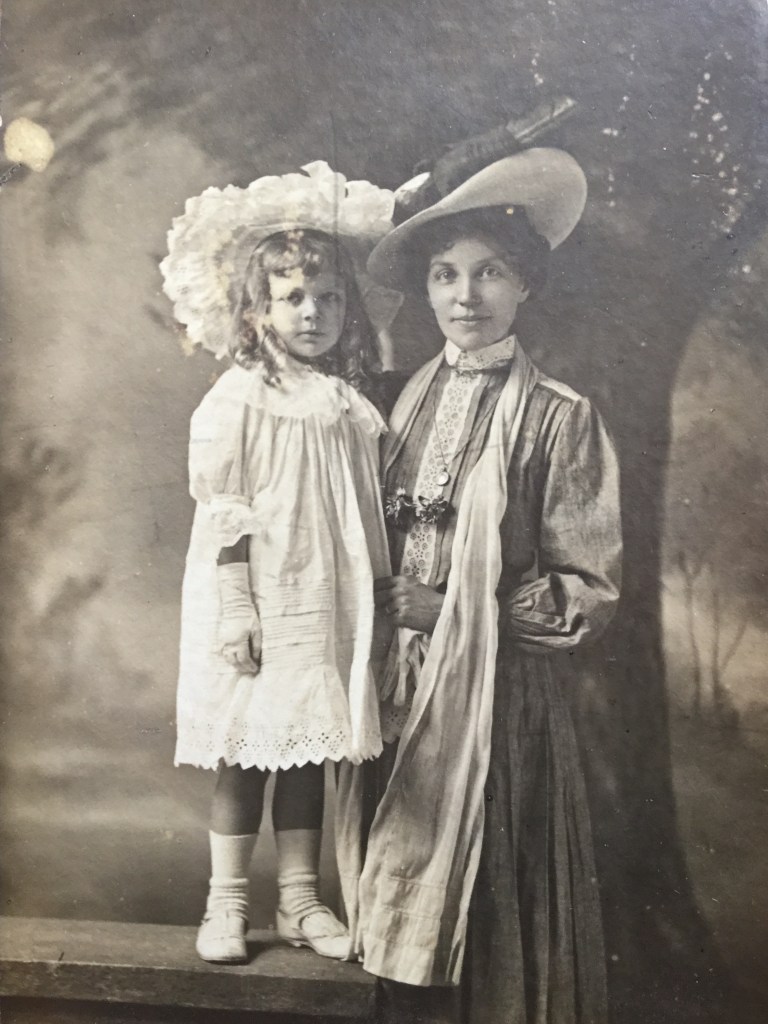
Our parents and grandparents will probably have those family albums which as Bates comments will be taken out at appropriate times and stories re-told. Of course this isn’t so common these days and most of our archival images are stored on social media, I’m thinking facebook in particular.
Talbot’s meta archive
William Henry Fox Talbot carefully chose images for his book, The Pencil of Nature, (1844-45). The book shows the specific capacity of photography to ‘remember things’. He includes images such as the construction of Nelson’s column in Trafalgar square, his old college, images of glass and crockery sets, a precursor to the various types of archives that are produced by the millions of photographers today. Bates asks: What effect does this have on actual human memory?
Prosthetic memory
Foucault argues that the effect of these (ideological) apparatuses has been “reprogramming popular memory, which existed but had no way of expressing itself. So people are shown not what they were, but what they must remember having been”
(Tandfonline.com. 2020.)
I find this a very interesting quote. What we do today is create a specifically edited view of ourselves that we wish to present to the world. Perhaps the family archive was no different. The question is whether photography is/has been a ‘truthful’ medium of our history or a means to construct a view of how we wish to see ourselves and the world around us.
Mnemic traces
Freud suggests that memory is stored in the pre-conscious. The unconscious mind has no concept of time and reality. Our earliest childhood memories vary from snippets from a few months old to memories from when we are six or seven. He suggests that these memories are likely distorted and retroactive, attached to events or desires. Infantile amnesia is unlikely to be explained by an undeveloped mind.
Freud uses the term ‘screen memories’ which are neither true or false. Rather they attach themselves to unconscious desires and fantasies. Intermingled with this are myths and fairytales.
The photograph is therefore a subjective thing. We regard it often as an accurate representation, a truth but in reality each image is a subjective construction based on a complex set of experience, unconscious desire and myth.
References and Bibliography
- Tandfonline.com. 2020. [online] Available at: <https://www.tandfonline.com/doi/pdf/10.1080/17540763.2010.499609?needAccess=true> [Accessed 25 April 2020].
 Landscape, Place and Environment