Joseph Campbell
Joseph Campbell is probably best known for his book, “The Hero with a Thousand Faces” which was first published in 1949. Campbell is particularly interested in mythology. What he proposes is that all great myths/stories/religion follow broadly the same narrative: ‘The Hero’s journey’.
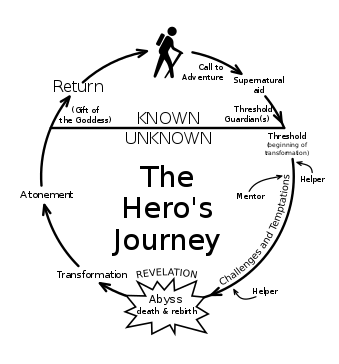
In general terms, what Campbell is suggesting is that these stories represent human growth and the search for identity. The Hero goes on a journey of transformation by stepping out of his ‘comfort zone’ and his familiar world to battle foes, obtain a prize and return victorious.
There are familiar characters in these stories, ‘The Mentor’ for example. Star Wars is a good example of a story that follows the structure of the Hero’s journey. Luke of course encounters Obi Wan Kenobi, his Father’s old teacher. (I’ve been told that George Lucus wrote Star Wars specifically to the stages of The Hero’s journey). The Mentor fulfils the role of directing the Hero, giving him advice, wisdom or teaching him skills that will aid his journey.
Then of course there is ‘The Shadow’, the enemy, nemesis, the evil witch/spirit/demon. This is the character that interests me the most. In the case of Star wars, it is of course Darth Vader who, we find out is actually Luke’s Father. Conveniently, what Luke battles is not just the prospect of defeating Darth Vader in battle but battling with his own ‘dark side’. This relates nicely to the Jungian archetype of the Shadow which I’m going to look at in more detail below.
Usually, halfway through this journey is a moment of despair where everything is looking bleak and the Hero may regret his decision to embark on this quest. There is self doubt, thoughts of giving up but the hero usually realises something about himself and finds the will to carry on. I think this is a very relatable situation. Many of us can recall situations like this but as we look back on them, we usually realise that we learned valuable skills during this process.
Eventually, evil is defeated, the Hero gains his prize and there is generally a happy ending.
If Campbell were alive today, my question to him would be “What about the Woman’s journey?”. I found myself wondering if the’Hero’ was directly interchangeable with the ‘Heroine’? In the Hero’s journey, Women are often to be rescued and/or are the prize. Is there a different path for Women? A question for another day.
Psychological associations
“Entering the Dark Forest or the Enchanted Forest is a threshold symbol; the soul entering the perils of the unknown; the realm of death; the secrets of nature, or the spiritual world which man must penetrate to find the meaning.”
(Fraim, 2001)
From a psycho-analytical perspective, the forest is usually associated with the unconscious mind. Jung found it unsurprising that forests feature so heavily in our fairytales as they were representative of the realm of the unconscious and our journey through life.
The Shadow archetype
From a Jungian perspective, the shadow is that part of the Self that we tend to repress. As we grow and develop through childhood, we are rewarded for ‘good behaviour’. This is essential for the development of the Ego. In many respects we can relate the Ego to our Hero above. It is the Ego (in simple terms) that we present to the world and provides us with our direction in life.
Our ‘Shadow selfs’ are those parts that we have hidden, they are the less desirable aspects of our character but not always entirely negative. Jung suggested that embracing and getting to know our ‘darker’ side was an essential part of our personal growth and a route to individuation.
Without a well-developed shadow side, a person can easily become shallow and extremely preoccupied with the opinions of others, a walking Persona. Just as conflict is necessary to advancing the plot of any good novel, light and dark are necessary to our personal growth.
(The Jungian Model of the Psyche | Journal Psyche, 2020)
Parts of our Shadow can be our wilder and more creative side. I think it’s necessary for us to know ourselves in an honest way. Know our ‘faults’ and ‘own’ our faults. Perhaps this does follow on to self acceptance and self compassion but also a way of moderating those darker aspects so they can manifest in a more positive way.
References and Bibliography
- Campbell, J., 1999. The Hero’s Journey. Dorset [England]: Element.
- Scott Jeffrey. 2020. Hero’S Journey Steps: 10 Stages To Joseph Campbell’s Monomyth. [online] Available at: <https://scottjeffrey.com/heros-journey-steps/> [Accessed 28 March 2020].
- TV Tropes. 2020. Shadow Archetype – TV Tropes. [online] Available at: <https://tvtropes.org/pmwiki/pmwiki.php/Main/ShadowArchetype> [Accessed 28 March 2020].
- LensCulture, C., 2020. Shadow Within – Photographs And Text Bychristian Houge | Lensculture. [online] LensCulture. Available at: <https://www.lensculture.com/articles/christian-houge-shadow-within> [Accessed 28 March 2020].
- Fraim, R., 2001. Symbolism.Org: Symbolism Of Place: 2. Natural Places. [online] Symbolism.org. Available at: <http://www.symbolism.org/writing/books/sp/2/page4.html> [Accessed 28 March 2020].
- Journalpsyche.org. 2020. The Jungian Model Of The Psyche | Journal Psyche. [online] Available at: <http://journalpsyche.org/jungian-model-psyche/> [Accessed 28 March 2020].
 Landscape, Place and Environment