Mythology, Folklore and Fairytales
The forest occupies a series of complex associations within our collective consciousness. It is a place of mystery and magic, the setting for many fairytales. It represents something ancient and enduring, a place to find shelter and forage for food. It can also represent a place of darkness and danger. It’s these associations and levels of symbolism that I want to draw upon within my work for Assignment two.
Forests, more specifically trees have a number of ‘divine’ and religious associations. For example: The tree under which Buddha received his enlightenment and the tree used for the crucifixion of Jesus. In the Shinto religion of Japan, the Sakaki tree has particular significance within the Japanese creation story and is used as a Shinto shrine. (Crewes, 2020). Specific trees or forests are regarded as spiritual or holy.
The physical nature of trees are easily anthropomorphised. Their central trunk and subsequent branches can take on a human appearance, even what can be interpreted as facial features on the trunk. There are associations of time in respect to the primordial nature of ancient forests, those trees that might be hundreds of years old, gnarled and shaped by the elements, possibly symbols of wisdom, next to the new young saplings together represent those cycles of life and nature.
Not surprisingly then, those symbols of the enduring nature of life, trees are often associated with fertility and provide the focus of a number of fertility rituals. We see reference to the ‘Tree of life’ in Yogic practice and Leonardo Da Vinci’s ‘Tree of Veins’ was used as a representation of the body’s circulatory system. (Crewes, 2020)
In more recent times, the forest existed in comparison to the town. This is something which is currently less definitive as the line between urban, rural and what might have been described as ‘wilderness’ in the past, becomes less distinct, simply due to increased population and industrialisation. However the symbolism of the ‘wild’ forest prevails in our literature and specifically fairytales.
Red riding hood ventured in to the forest and encountered the Wolf. Hansel and Gretel of course nearly get eaten by the witch. Traditionally, Snow White, Sleeping Beauty, Beauty and the Beast all have the forest feature heavily. More modern fairytales like ‘The Enchanted forest’, ‘The Narnia Chronicles’ and even ‘The Gruffalo’ are also set in this magical realm of the forest.
What these childhood stories represent are journeys into the unknown where ‘dark perils’ await and are defeated. We can imagine these stories being told to children to warn them against straying too far from the path or being wary of strangers. The stories also represent a test of some kind and a rite of passage which relate nicely to the idea of a journey.
Ellie Davies
“A forest is what exists between its trees, between its dense undergrowth and its clearings, between all its life cycles and their different time-scales…A forest is a meeting place between those who enter it and something unnameable and attendant…Something intangible and within touching distance. Neither silent nor audible.”
—John Berger, Hold Everything Dear: Dispatches on Survival and Resistance
(Lensculture, 2020)
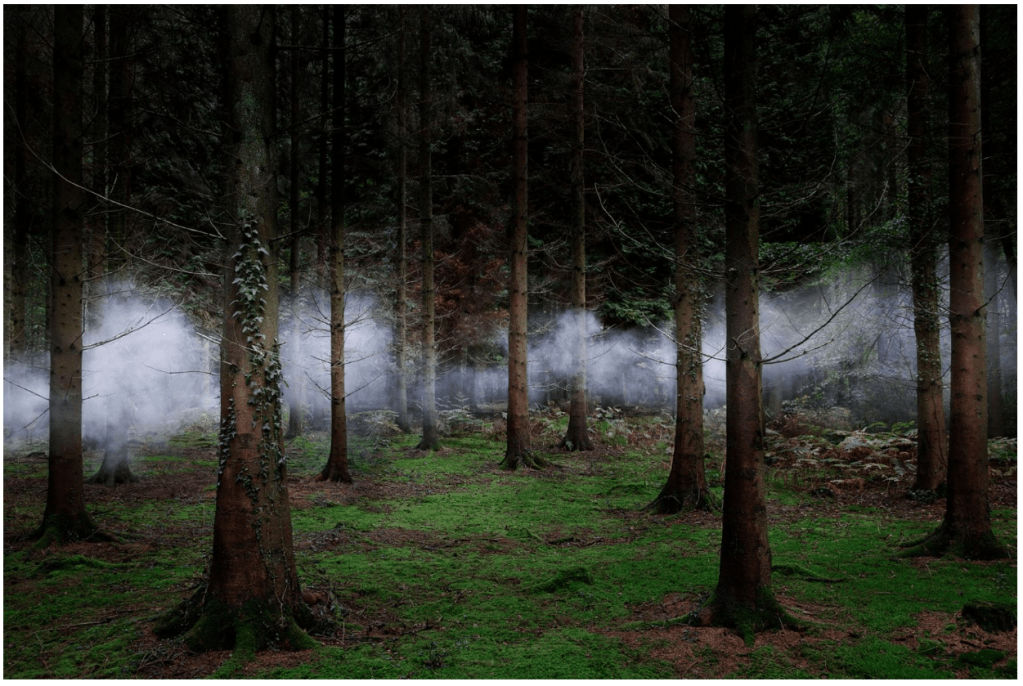
Ellie Davies who lives in Dorset has produced a body of work photographing the woods and forest of Southern England. In many of her projects, she uses land art and draws upon this sense of the ‘other place’. When I was out photographing Rendlesham forest recently, I certainly had that feeling. On one occasion it was windy and the sound of the trees, the whooshing and creaking, gave me a childlike excitement.
Between the trees uses smoke that sits like clouds or mist in amongst the trees which for me represents breath (of life?). Trees and forests are often analogous to lungs because of their ability to provide us with oxygen which also adds to this sense of a ‘living’, in an anthropomorphic sense, entity.
The images have a darkness to them which contrasts well with this floating, ethereal smoke. Davies focuses on the space between as if we can enter this space and disappear into another world.
Anna Beeke
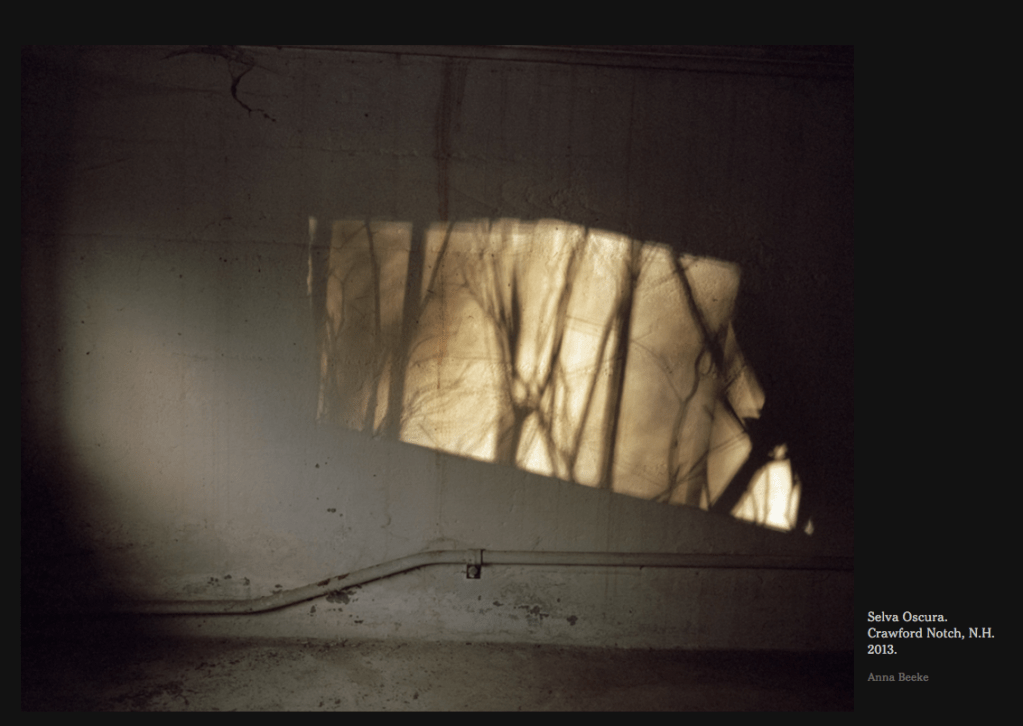
Anna Beeke completed her project as part of her studies. It began as a journey around the forests of Western America trying to find a story. What she found eventually was the human interaction with the forest. There were those living in hidden houses, a tree mural which had been painted across an ugly structure to disguise it and the inevitable, logging.
Whilst some of the images are directly of the forest, some are how the forest creeps into our lives and perhaps into our consciousness. The image above for example shows how the trees cast a shadow on the wall making it beautiful. The same is true of the image of the tree mural. I think it shows our connection with trees and forests in terms of their beauty, of nature and something deeper.
Jitka Hanzlova
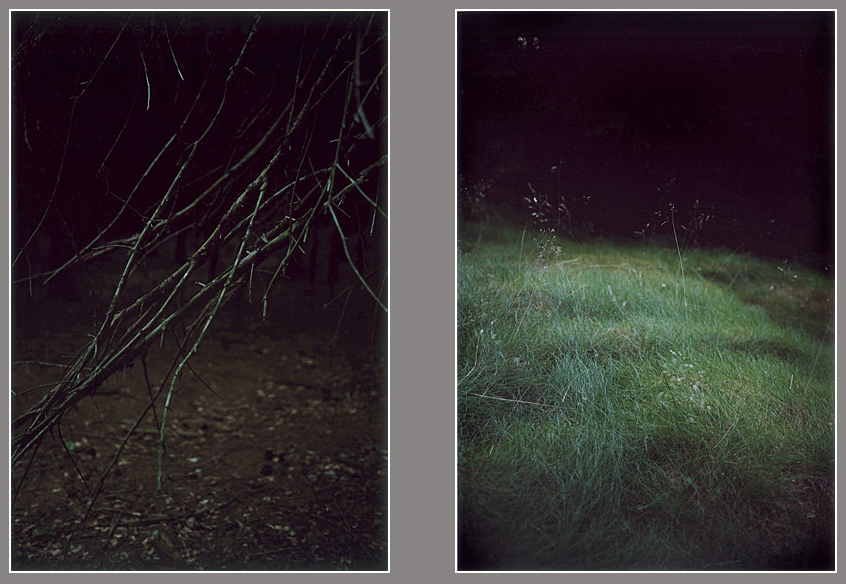
There’s no accompanying text to Hanzlova’s images. In the main, they are dark and beautiful, something that I should bear in mind for my own project. There’s a sense of moving through the forest, picking out individual elements, many of which have a tactile quality, something that I felt when I was walking through Rendlesham, I wanted to kick the leaves and stroke the branches.
There is a sense of the light filtering through the trees highlighting these individual elements. I think it’s this that gives the work a sense of a journey and discovery. Portrait orientation works well here, it narrows the view, again something for me to consider.
References and Bibliography
- Crewes, J., 2020. Perceptions Of Forests. [online] Fao.org. Available at: <http://www.fao.org/3/y9882e/y9882e08.htm> [Accessed 9 March 2020].
- Krueger, J., 2015. Waldeslust – Joy Of The Forest. [online] Psychology Today. Available at: <https://www.psychologytoday.com/us/blog/one-among-many/201502/waldeslust-joy-the-forest> [Accessed 9 March 2020].
- Gaunt, J., 2011. The Fairytale Forest – A Source Of Symbolism. [online] Woodlands.co.uk. Available at: <https://www.woodlands.co.uk/blog/flora-and-fauna/the-fairytale-forest-–-a-source-of-symbolism/> [Accessed 9 March 2020].
- Fraim, J., 2001. Symbolism.Org: Symbolism Of Place: 2. Natural Places. [online] Symbolism.org. Available at: <http://www.symbolism.org/writing/books/sp/2/page4.html> [Accessed 9 March 2020].
- LensCulture, 2020. Ellie Davies | Lensculture. [online] LensCulture. Available at: <https://www.lensculture.com/ellie-davies> [Accessed 9 March 2020].
- Silverman, R., 2014. [online] Available at: <https://lens.blogs.nytimes.com/2014/12/15/a-photographers-forest-tale/> [Accessed 9 March 2020].
- Hanzlova, J., 2020. Jitka Hanzlová : FOREST. [online] Jitkahanzlova.com. Available at: <http://www.jitkahanzlova.com/works/forest_03.htm> [Accessed 9 March 2020].
- System, N., 2020. Sylvania. [online] Annabeeke.com. Available at: <http://www.annabeeke.com/projects/sylvania/Sylvania1/> [Accessed 16 March 2020].
 Landscape, Place and Environment