Firstly I am going to say, as far as I’m concerned, anything goes. That’s not to say that we will agree with or like everything that is presented as ‘art’. It must however have it’s freedom of expression.
Appropriation art or the art of appropriation is the use of pre-existing objects or images with little or no transformation applied to them.
(Artlyst.com, 2020)
Marcel Duchamp
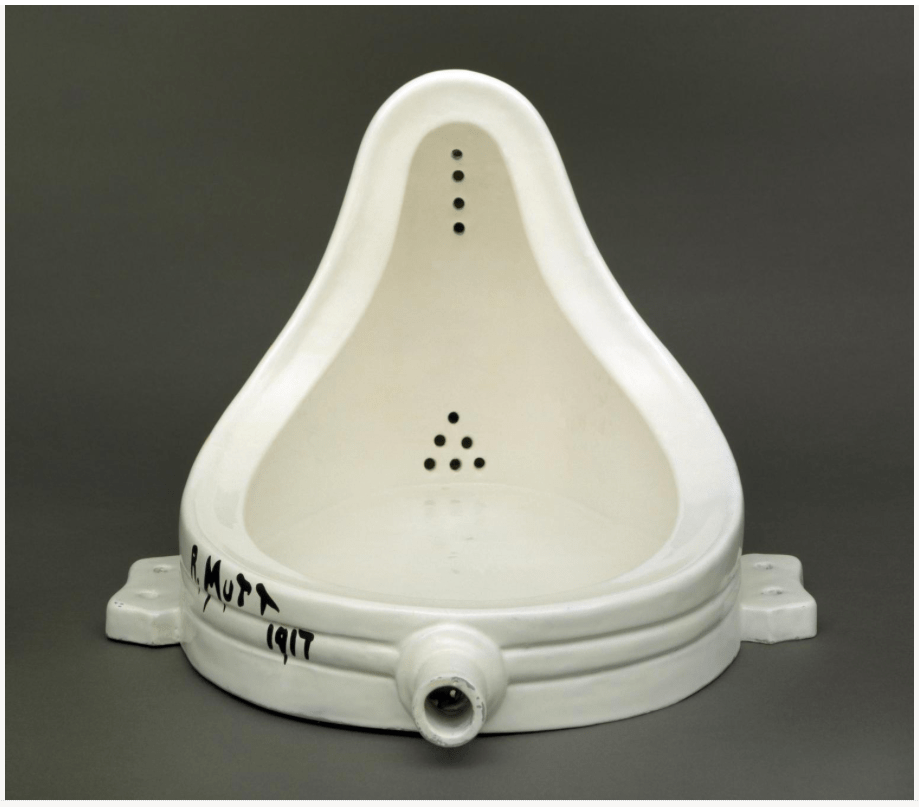
(Tate, 2020)
I hadn’t realised the story behind the “Fountain”. DuChamp submitted it anonymously to test out the principles of the gallery board. Although included in the original listing for the exhibition, it was withdrawn an hour before opening as it was not deemed suitable. DuChamp tracked down his urinal and got the gallery owner Alfred Stieglitz to photograph it. Although it was subsequently ‘lost’, Steiglitz’s image remained as evidence of the piece.
Stieglitz was proud of the image, writing in a letter dated 23 April 1917, ‘The “Urinal” photograph is really quite a wonder – Everyone who has seen it thinks it beautiful – And it’s true – it is. It has an oriental look about it – a cross between a Buddha and a Veiled Woman’
(Tate, 2020)
The “Fountain” is probably the first of it’s kind known at the time as ‘readymades’ or as we now use the phrase appropriation. I find it wonderfully subversive and challenging. Probably not by today’s standards but in its time a shake-up to the ‘establishment’. It seems a general theme in appropriation art that there is a sense of subversion and socio-political challenge.
Barbara Kruger
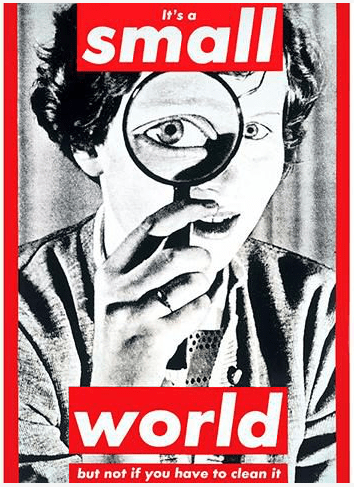
I love Barbara Kruger. Her work is a precursor to todays ‘memes’ and probably the ‘gift shop’ style of statement art a lot of homes. I have one in my kitchen with an image of a 1950’s housewife that says: “Coffee, if you’re not shaking, you need another cup.” It was funny at the time. Kruger was challenged on the use of this image but won her case as the image was considered in the public domain.
Andy Warhol
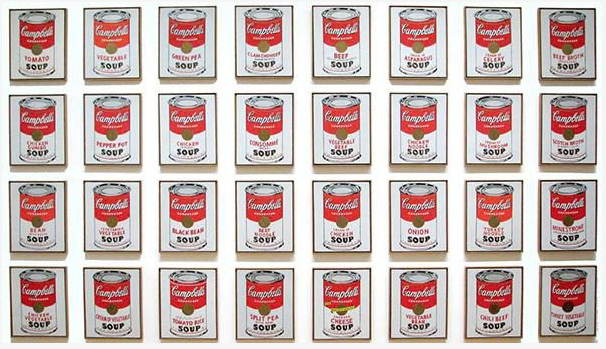
Warhol borrowed a lot of items from popular culture to question the originality of art but mainly a comment on consumerism.
Michael Wolf and Jon Rafman
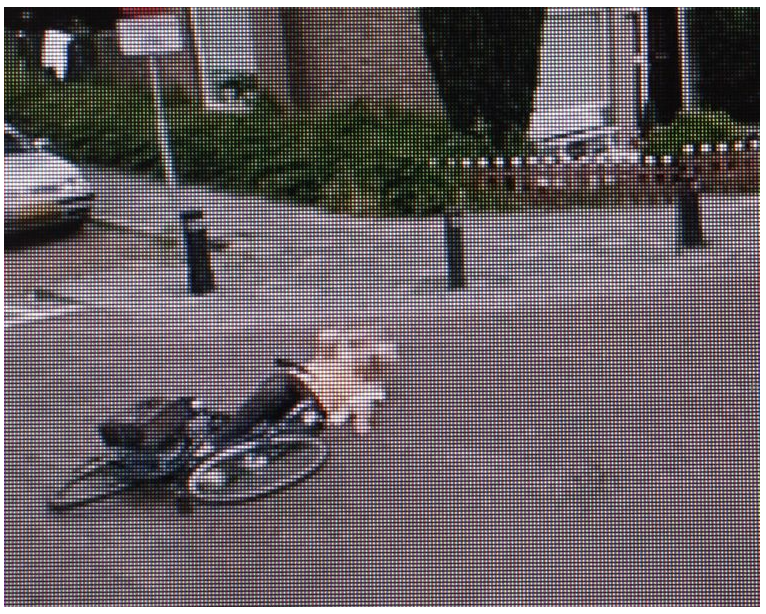
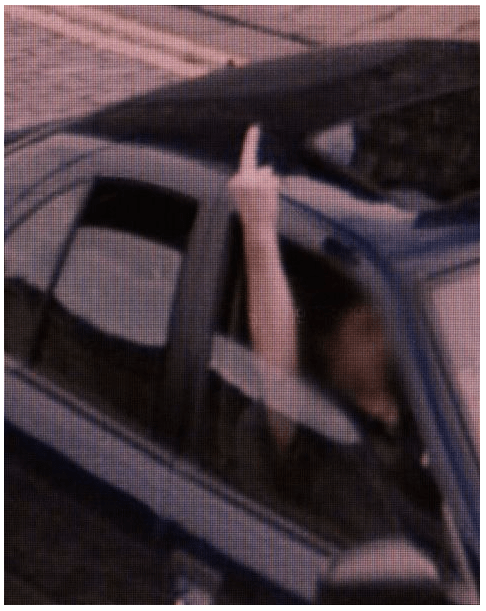
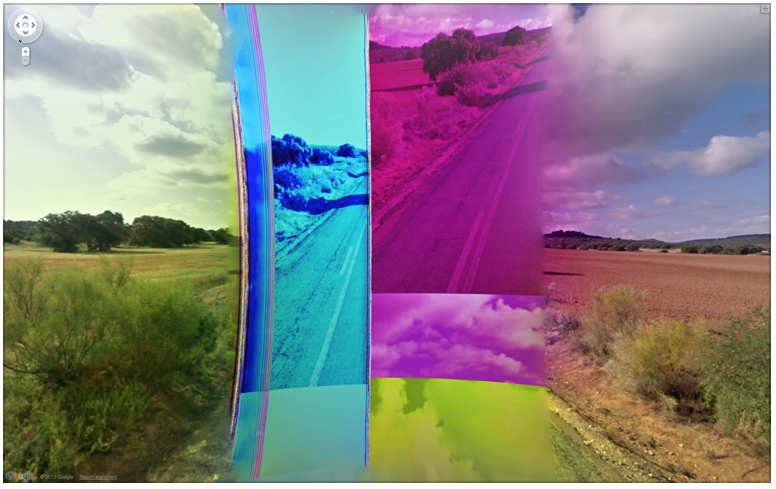
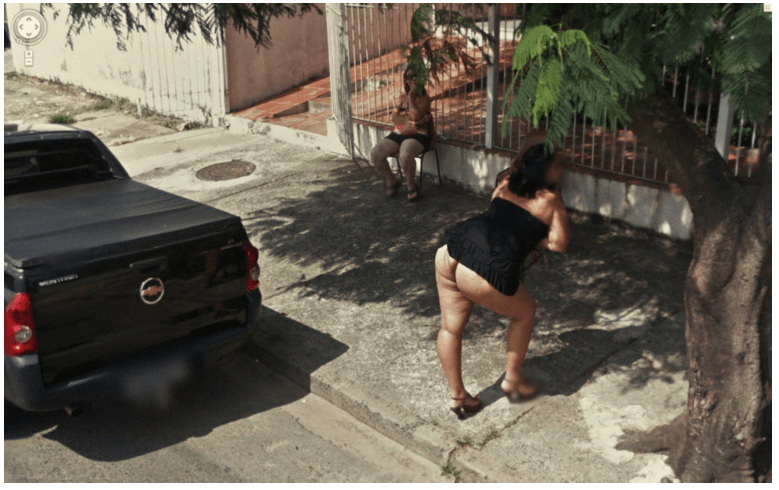
Both Wolf and Rafman have used images from Google street view. Both photographers have spent hours trawling the images to present often human’s at their basest. Of course the debate is, is this really photojournalism as neither Wolf or Rafman have taken these images themselves but there are overlaps in the images presented. Dyer asks, so whose images are they? To which Rafman replies:
That, in Rafman’s beautiful formulation, is part of the conceptual underpinning of this shared activity. These, he writes, are “photographs that no one took and memories that no one has”.
(Dyer, 2020)
If I’m honest, the sheer volume of these images means that after a while, I’m a bit bored by them. There’s a lot of human beings being generally crap which probably says I’m a bit of a snob! Maybe that’s the point with these images, that they’re not particularly memorable, they’re a bit sad.
Assignment planning next post.
References and Bibliography
- Oca.ac.uk. (2020). [online] Available at: https://www.oca.ac.uk/weareoca/archived/whos-afraid-of-appropriation/ [Accessed 11 Feb. 2020].
- Dyer, G. (2020). How Google Street View is inspiring new photography. [online] the Guardian. Available at: https://www.theguardian.com/artanddesign/2012/jul/14/google-street-view-new-photography [Accessed 11 Feb. 2020].
- Artlyst.com. (2020). [online] Available at: https://www.artlyst.com/features/top-10-appropriation-artworks/ [Accessed 11 Feb. 2020].
- British Journal of Photography. (2020). Doing a Double Take on image appropriation. [online] Available at: https://www.bjp-online.com/2017/03/doing-a-double-take-on-image-appropriation/ [Accessed 11 Feb. 2020].
- Meiselman, J. (2020). When Does an Artist’s Appropriation Become Theft?. [online] Artsy. Available at: https://www.artsy.net/article/artsy-editorial-artists-appropriation-theft [Accessed 11 Feb. 2020].
- Tate. (2020). ‘Fountain’, Marcel Duchamp, 1917, replica 1964 | Tate. [online] Available at: https://www.tate.org.uk/art/artworks/duchamp-fountain-t07573 [Accessed 11 Feb. 2020].
- 9-eyes.com. (2020). jon rafman. [online] Available at: https://9-eyes.com/page/6 [Accessed 11 Feb. 2020].
- LensCulture, M. (2020). A Series of Unfortunate Events – Photographs byMichael Wolf | LensCulture. [online] LensCulture. Available at: https://www.lensculture.com/articles/michael-wolf-a-series-of-unfortunate-events#slideshow [Accessed 11 Feb. 2020].
 Landscape, Place and Environment