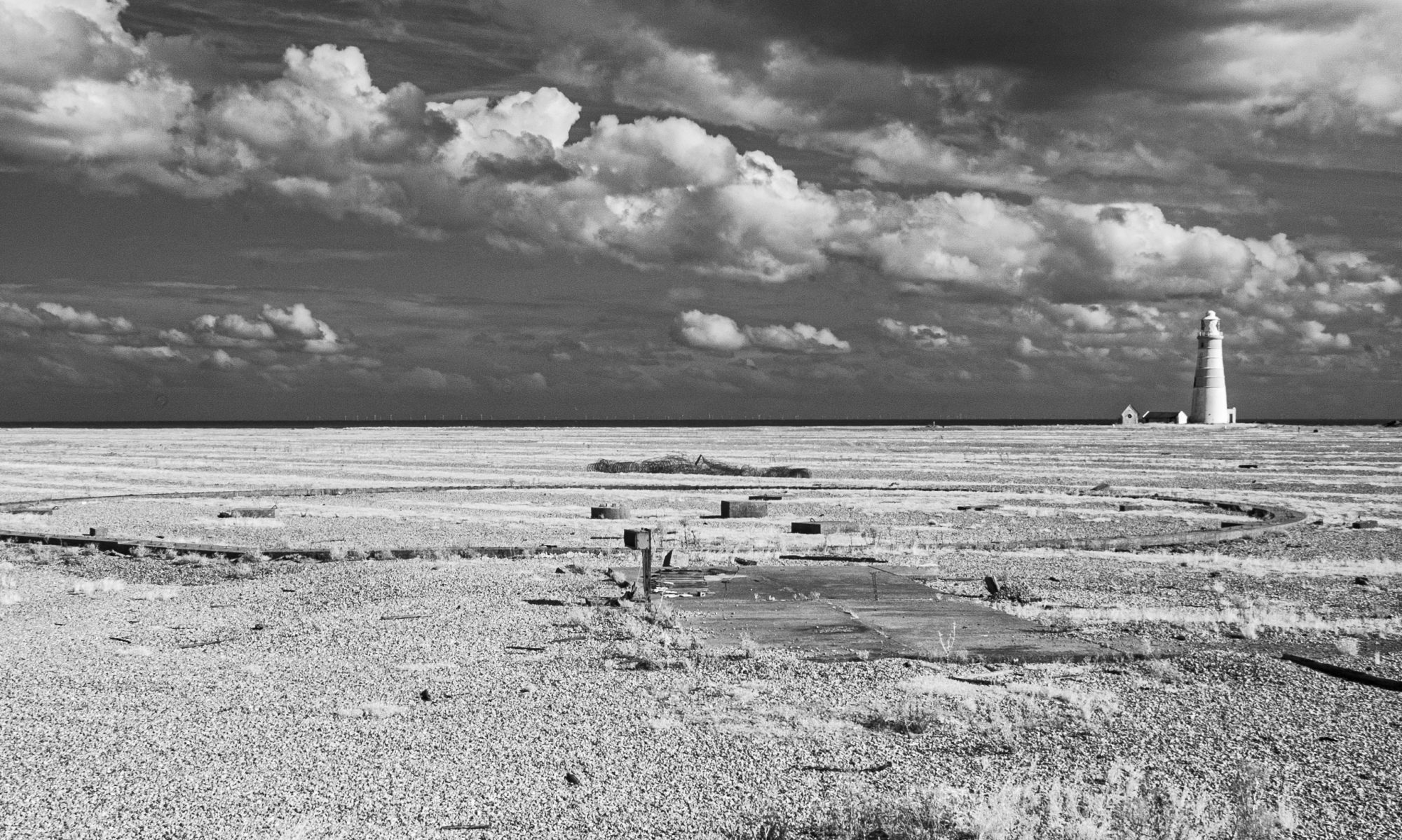
Definitions
Typologies
Topographies
Sean O’Hagan’s article on the 1975 exhibition “Photographs of a Man-Altered Landscape”, is a commentary on the ‘aesthetics of the banal’. It’s interesting that in Part one of this unit, we were looking at early photography which was generally topographic in nature. There was a desire then for photographers to follow the traditions of painters and create images which were ‘beautiful’, postcard representations of the landscape.
It’s no surprise perhaps to learn that the exhibition was greeted with distaste. Frank Gohlke, one of the photographers exhibited, is quoted as saying: “I think it wouldn’t be too strong to say that it was a vigorously hated show.” (O’Hagan, 2020). I wonder if there is a perception from the viewer that images of what is considered banal, takes less creativity or technical expertise, and perhaps the then viewers felt short-changed by the exhibition.
The images seemed to hone in on the increasing encroachment of the industrialised world and the human impact on what had been previously presented as a ‘glorious natural world’. In the Tate video clip, Baltz makes reference to this, that photography has a specific mode as a ‘deductive art’. He states that photography begins with a world that is overfull and singles out those specific elements to highlight social, could even be political aspects that the viewer is encouraged to engage with.
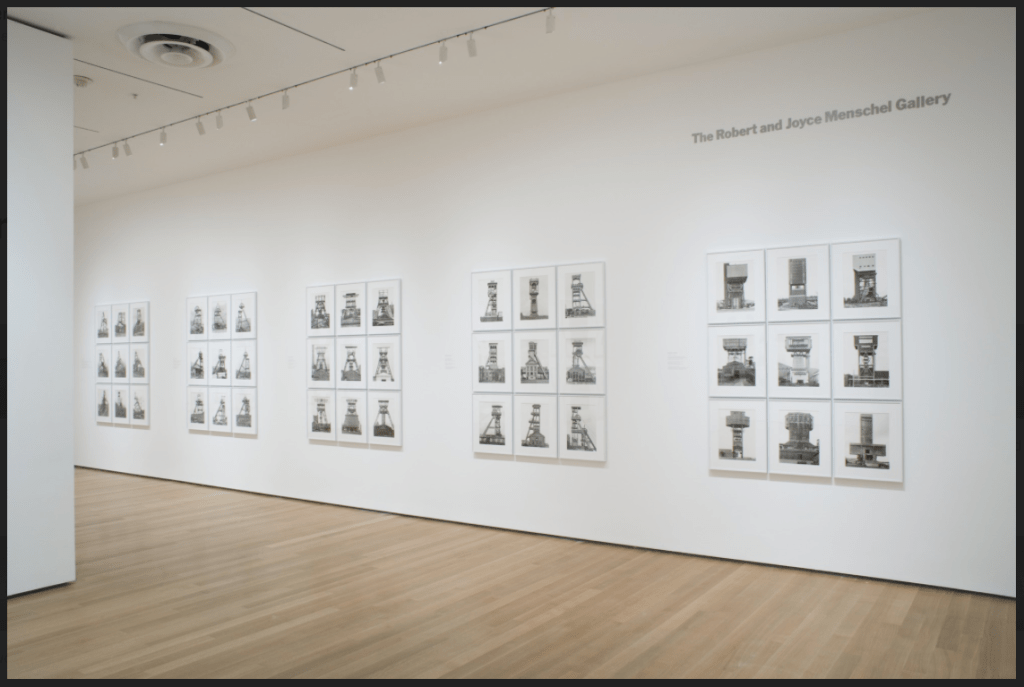
The Bechers images of mines and steel mills (above) have a beautiful architectural quality but I suspect that it is the subject matter that would have presented a problem for the viewers at the time. Maybe if this had been images of churches or mountains it would have been perceived differently. However as O’Hagan points out, this style of typological approach has prevailed and is seen to influence modern photographers. I think it represents a turning point into what O’Hagan describes as a “certain strand of theoretically driven photography”. It is socio-political and historical.
Whether this genre of photography is classed as ‘beautiful’ is determined by the viewer. It could be seen as a testament to ‘Man’s’ invention and progression or as our encroachment and destruction of the natural world.
Lewis Baltz
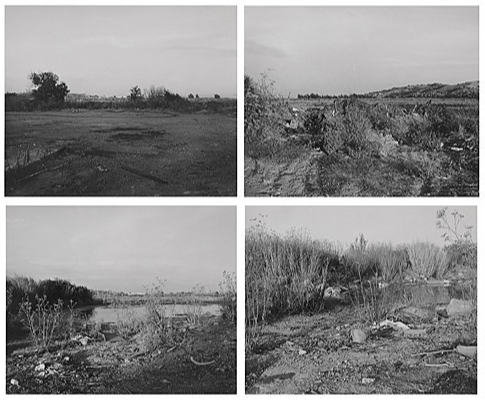
(Guggenheim, 2020)
Baltz’s earlier works in black and white focus on the post-war urbanisation of the landscape. Inkeeping with the style of ‘New Topological movement’, he presented his images taken of changing landscapes over a period of time in a grid like fashion which to me evokes a scientific or text-book feel. The work had a strongly dispassionate sense. Baltz is quoted as saying that he admires beauty however is happy to leave that for others. His interest was in creating images that were interesting to think about rather than just interesting to look at.
Where his earlier work was centred around landscape, particularly man’s effect and intervention, his later work, in colour depicts the rise in technology.
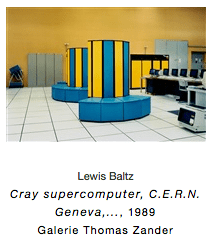
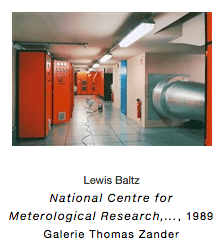

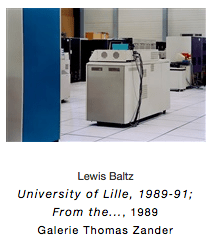
Rather than man altered landscapes, his later work could be described as man-made landscapes, albeit indoor. Forests of supercomputers made from the pure elements taken from the earth. Man’s quest for understanding and control. When asked why he doesn’t include people in his images, Baltz states that what he includes is evidence of human effort. I take this statement as one without judgment. In current times there is an overwhelming realisation that we have taken things too far in terms of how we treat our planet. This has become a collective viewpoint albeit not a unanimous one. Whilst the viewer can project their own political viewpoint on the images, I wonder if typological approach is there to simply hold a dispassionate mirror up to us all.
References and Bibliography
- O’Hagan, S. (2020). New Topographics: photographs that find beauty in the banal. [online] the Guardian. Available at: https://www.theguardian.com/artanddesign/2010/feb/08/new-topographics-photographs-american-landscapes [Accessed 10 Feb. 2020].
- http://www.dictionary.com. (2020). Definition of topographic | Dictionary.com. [online] Available at: https://www.dictionary.com/browse/topographic [Accessed 10 Feb. 2020].
- http://www.dictionary.com. (2020). Definition of topographic | Dictionary.com. [online] Available at: https://www.dictionary.com/browse/topographic [Accessed 10 Feb. 2020].
- Guggenheim. (2020). San Quentin Point. [online] Available at: https://www.guggenheim.org/artwork/31795 [Accessed 10 Feb. 2020].
- The Museum of Modern Art. (2020). Bernd and Hilla Becher: Landscape/Typology. [online] Available at: https://www.moma.org/calendar/exhibitions/95?locale=en&installation_image_index=4 [Accessed 10 Feb. 2020].
- Artnet.com. (2020). Lewis Baltz | artnet. [online] Available at: http://www.artnet.com/artists/lewis-baltz/ [Accessed 10 Feb. 2020].
 Landscape, Place and Environment