Summary of Essay by Joel Snyder
- Initial ideas on the ‘character’ of Photography from it’s ‘invention’ in 1839 was one of puzzlement as to what Photography was and how it stood in relation to other image making practices i.e painting, drawing. The photographic prints were seen as machine made. Photographs were seen as mechanical and technological in comparison to the spiritual and imaginative nature of handmade images.
- The inception of photography coincided with general advances in technology, i.e Industrial revolution. It’s initial audience was the growing middle class allied to a more popular culture and technological progress.
- The market for photographs (1850’s-1870’s) was largely based around what could be described as tourism. Small local photographic businesses produced photographs of geological interest either singly or as albums.
- Photography therefore became defined as factual, material and physically real as opposed to a more cognitive and imaginative realm of ‘art’. Printing processes moved towards a highly polished, glossy finish in distinct sepia tones.
- Carleton Watkins married the asthetic of the highly polished finish with the existing conventions of the picturesque and the sublime producing large prints of Landscapes for example of Yosemite.
- Watkins success of his Yosemite series encouraged him to extend his work to other areas of the American west. He also was commissioned to work on geological surveys, producing garden of eden like images that portrayed the unspoilt landscape prime for real estate development.
- Synder does not suggest that Watkins had any specific narratives towards political considerations of the Landscape but merely that he was a ‘champion of development and keen on ideas of progress.
- In contrast, Timothy O’Sullivan was also photographing the American West in a way that showed a bleak inhospitable Landscape. He had a background in War/battlefield photography.
- Krauss states that O’Sullivans images occupy a different discursive space to that of the Parisian painters. They are seen as descriptive and scientific in character. O’Sullivan’s bosses however saw the images as incapable of providing true measurement and quantification and that the images were taken to provide a ‘sense of the place.
- Adams retrospectively describes O’Sullivans images as technically poor however with a surrealistic and disturbing quality.
- Despite criticism of this genre of photography as being purely scientific in nature, the respective photographers manage to depict contrasting narratives of the landscape. For Watkins and subsequently William Henry Jackson, there is an inviting, hospitable and familiar feel to the images whereas O’Sullivan depicts a wild and formidable Landscape.
Timothy O’Sullivan – Cooley’s Park, Sierra Blanca Range
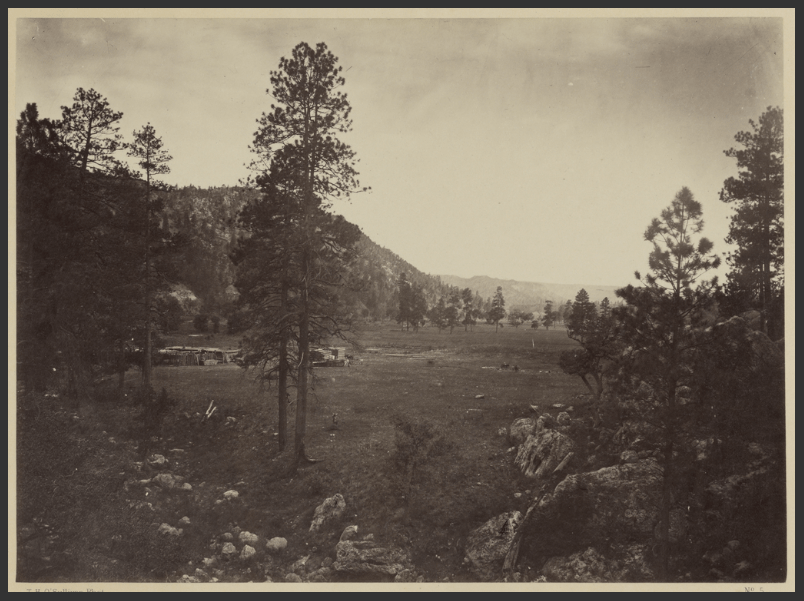
The above image has an element of the picturesque however the central tree sits in a position that feels challenging almost as Synder suggests that O’Sullivans work represents a “pictorialised ‘No Trespassing’ sign”. The viewer is invited to ‘peak’ through the trees to the unknown Landscape beyond. There is something compelling about the image as Adams commented on O’Sullivans work, something ‘surrealistic and disturbing’. It is not beautiful in any senses of the word, there is no technical refinement whether that be in composition or exposure (albeit a digital representation of an old photograph!).
Carleton Watkins – El Capitan at the Foot of the Mariposa Trail, 1865-66
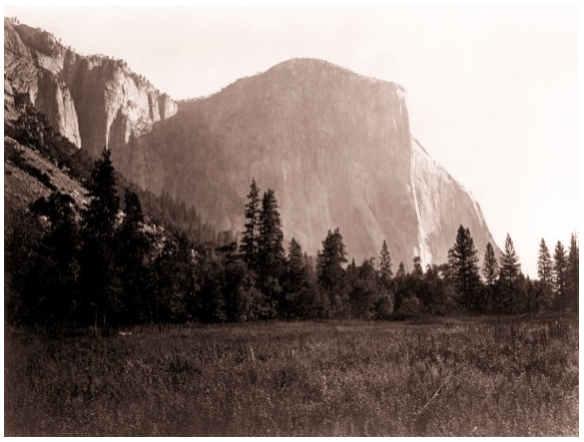
In contrast to O’Sullivans image, Watkins photograph of El Capitan has a more polished aesthetic. The composition is more considered as a pleasing and inviting image. Whilst Snyder implies Watkins enthusiasm for the development of the West, the Fraenkel gallery text suggests a more naturalistic approach which presents a sense of majesty of the natural world which is instrumental in securing Yosemite as a National Park. This of course involves it’s own level of development albeit under the guise of protection. Yosemite is of course now a major tourist attraction with economic benefit.
Carleton E. Watkins, born in 1829, is considered one of the greatest photographers of the American West. Traveling the western United States, he made thousands of mammoth and imperial plate photographs of the Yosemite Valley, Columbia River, the Sierra Nevada, and the Pacific Coast in Oregon. His pictures of Yosemite Valley served an essential role in Congress’ establishing Yosemite as a National Park in 1864. Watkins’ photographs of the West remain as important historical documents of the landscape, showing a moment before the onslaught of massive development.
(Fraenkel Gallery, 2020)
References
- Mitchell, W. (2009). Landscape and power. Chicago, Ill: Univ. of Chicago Press.
- The J. Paul Getty in Los Angeles. (2020). Cooley’s Park, Sierra Blanca Range, Arizona (Getty Museum). [online] Available at: http://www.getty.edu/art/collection/objects/40248/timothy-h-o’sullivan-cooley’s-park-sierra-blanca-range-arizona-american-1873/ [Accessed 4 Feb. 2020].
- Fraenkel Gallery. (2020). Carleton E. Watkins | Fraenkel Gallery. [online] Available at: https://fraenkelgallery.com/artists/carleton-watkins [Accessed 4 Feb. 2020].
 Landscape, Place and Environment