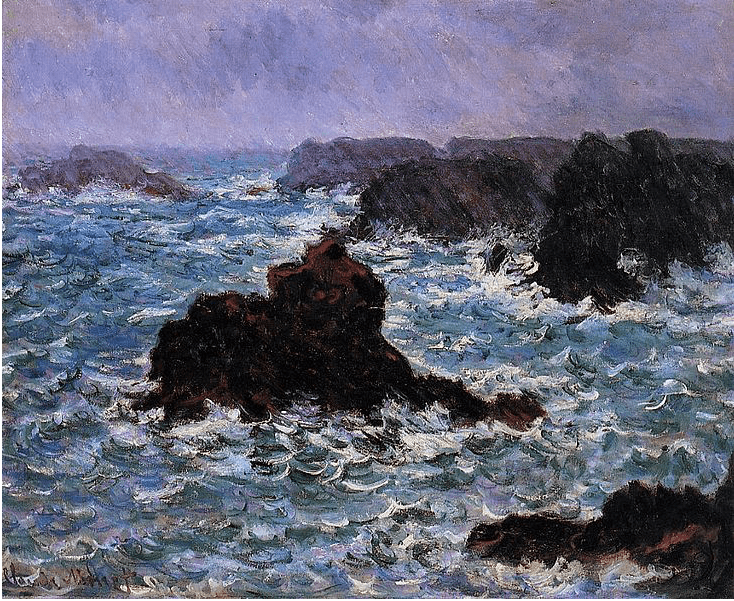
This is a review of a journal article in ‘New Literary History’ written by Stephen Levine in 1985. Based on the accounts of various artists who travelled to see the sights of ‘Belle-ile-en-mer, a small island off the coast of Brittany, the overall language of the piece evokes the excitement, terror and euphoria experienced by the artists who immersed themselves in the splendour of the area to experience the Sublime. Below is how Flaubert describes his experience.
“Our spirit revolved in the profusion of these splendors, we drank them in with our eyes; we flared our nostrils to them, we opened our ears to them; something of the life of the elements, emanating by themselves under the attraction of our glances, reached us, became assimilated to us, made us understand them in a less distanced way, made us feel closer to them, by virtue of this more complex union.”
(Levine, 1985)
There is very much the spirit of the adventurer and a sense of heroism. There are accounts of how Vernet was seen ‘strapped to the mast of a ship’ in the storm and how Monet was seen dressed in oilskins like the local fishermen with his canvases ‘lashed to a rock’ furiously painting a storm. It was even written that as the gale force winds ripped his palette and brushes out of his hand, he began anew “without becoming discouraged”.
There a sense that the sublime represents a gendered aesthetic. There are patriarchal associations with ruggedness and power. (Andrews, 2005). Whilst Burke’s viewpoint is that power exists as a deity, Kantian interpretations have been more towards Man’s dominion over Nature. Burke’s interpretation of beauty takes on the expectation of what is ‘properly feminine’ such as fragility and submissiveness.
In a pamphlet published in 1886 entitled “Science and Philosophy in Art” by Celen Sabbrin, she describes Monet’s pictures as “an art of fixation, arrest, death.” (Levine, 1985) The sea is almost always referred to in the feminine, ‘she’, and often there is the idea of luring Men to their death.
“The gallery and all surroundings vanish, and it is the sea that spreads before you, with its restlessness. Innocence is depicted upon the siren’s countenance. In the past, how many adventurous mariners she has lured on to repose upon her trustful bosom, only to drag them to her distant abode, the dwelling of death (P. 15)”
(Levine, 1985)
Freud described this desire to seek death as the ‘Nirvana principle.’ Nirvana being a Buddhist reference to an end to the cycle of reincarnation to a tranquil state of enlightenment or death. Freud was theorising in a broad sense that we will tend to seek to undo anxiety, find safety so to speak. So whilst Burke talks about terror, it is viewed from a place of safety and in Kant’s view by recognising that safety we gain a satisfaction.
“In Diderot’s self-annihilation, Kant’s self-consciousness, and Schopenhauer’s contemplation; in Vernet’s ravissement and Monet’s jouissance, we find the sea offering the opportunity for displacement and discharge of the desire to return from the tremors of life to the inviting tranquillity of death.”
(Levine, 1985)
There’s lots to think about in Levine’s article. The Ocean evokes the sublime emotion of terror and is a common literary reference. The sea is a ‘she’ that is tempestuous and dangerous however there is a desire to submit to a ‘watery embrace’. I can’t help feeling that there’s some primitive desire to return to the womb.
- Commons.wikimedia.org. (2019). File:Claude Monet – Belle-Ile, Rain Effect.jpg – Wikimedia Commons. [online] Available at: https://commons.wikimedia.org/wiki/File:Claude_Monet_-_Belle-Ile,_Rain_Effect.jpg [Accessed 11 Dec. 2019].
- Levine, Steven Z. “Seascapes of the Sublime: Vernet, Monet, and the Oceanic Feeling.” New Literary History, vol. 16, no. 2, 1985, pp. 377–400. JSTOR, http://www.jstor.org/stable/468752. Accessed 21 Jan. 2020.
- Andrews, M. (2005). Landscape and Western art. Oxford [etc.]: Oxford University Press.
- Fsmitha.com. (2020). World History Timeline: 19th Century, 1821 to 1830. [online] Available at: http://www.fsmitha.com/time/ce19-3.htm [Accessed 21 Jan. 2020].
- Oxfordreference.com. (2020). Nirvana principle – Oxford Reference. [online] Available at: https://www.oxfordreference.com/view/10.1093/oi/authority.20110810105505456 [Accessed 21 Jan. 2020].
 Landscape, Place and Environment
