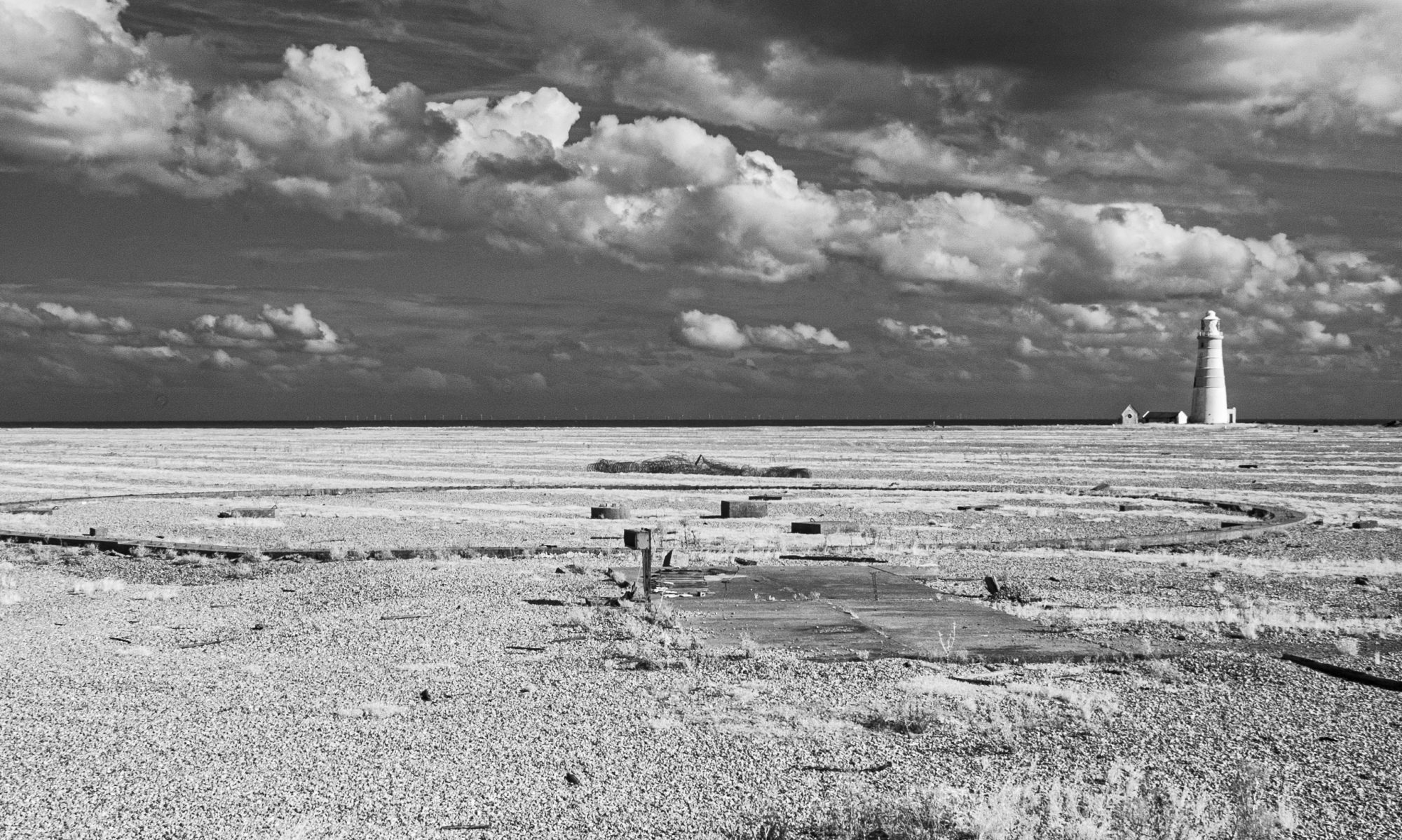
Burke, pleasure, pain and self-preservation
In 1757, Edmund Burke published his treatise on the aesthetics: “A Philosophical Enquiry Into the Origin of Our Ideas of the Sublime and Beautiful”. It provided a systematic analysis of the qualities of the sublime providing a theoretical framework and a legitimacy to the Romantic movement. (Wordsworth Trust, 2020)
Burke was considered an empiricist which means he believed our “formation of ideas and our knowledge of the natural world was derived from sensory experience.” (Wordsworth Trust, 2020) This is in contrast to the rationalist way of thinking that believed “knowledge of innate ideas can be arrived at through intuition and reasoning alone, independently of the passions” (Wordsworth Trust, 2020) Burke asserts that the emotions of terror, pain and fear of death are the strongest and concluded that these are centred towards self-preservation.
The passions that concern self-preservation, turn mostly on pain or danger. The ideas of pain, sickness and death, fill the mind with strong emotions of horror; but life and health, though they put us in a capacity of being affected by pleasure, they make no such impression by the simple enjoyment. The passions, therefore, which are conversant about the preservation of the individual, turn chiefly on pain and danger, and they are the most powerful of all the passions.
(Google Books, 2020)
Much of the horror Burke describes is directed at natural phenomena. He writes about “greatness, vastness and darkness” describing how the ‘unknown’ or the “terrible uncertainty of the thing” triggers the emotion of the sublime and notes that looking up at a mass of rock for example creates less of the feeling of horror than looking down into a dark bottomless pit, i.e uncertainty and infinity.
Kant, The mathematical and dynamic sublime
We call nature sublime when in fact it is ideas of reason that are sublime.
(Brady, 2012)
Where Burke’s definitions relate to sensory experience, Kant suggests the sublime is a form of self-transcendence. Burke refers to the ‘objects’ of nature themselves as being sublime whereas Kant’s critique suggests it is self-regarding. He describes the greatness and vastness as the ‘mathematical sublime’, one which induces initially a ‘negative inhibition’ at that greatness but is followed by a ‘positive moment’ driven by reason that we can ‘measure’ that greatness.
…the senses and imagination are pushed to the very limits of their powers when faced with the overwhelming magnitude of natural objects such as high mountains or the night sky, which are suggestive of the infinite. Through imagination’s attempt to “aesthetically comprehend” the absolutely great, and its subsequent failure, “the very inadequacy of our faculty for estimating the magnitude of the things of the sensible world awakens the feeling of a supersensible faculty in us”
(Brady, 2012)
The negative moment of the mathematical sublime occurs when the imagination is revealed as inadequate to grasping the magnitude of vast objects. The positive moment is the supplying of the idea of infinity by reason. Thus reason shows itself to exceed the ability of imagination for estimating magnitudes. Through reason we can think more than the world can ever present us with.
(flax, 2020)
Kant describes the dynamic sublime as one where ‘man’ experiences, in some ways, ‘power over nature. An example is, threatened by the forces of nature (the negative moment) but experiencing it from a safe spot, (the positive moment).
The dynamic sublime concerns the judgement of nature as having no dominion over us despite the immensity of its power.
(flax, 2020)
For Burke, nature is the sublime object. For Kant, it is Man’s reason and the nobility of the mind.
The spiritual sublime and expressionism
The Expressionist movement of the early 20th century was in many ways a continuation of the ideals of the Romanticists. Expressionism explored the use of colour, line and shape to evoke a strong emotional response. Many of the works were of a grand scale that gave the viewer an almost religious experience.
“Instead of making cathedrals out of Christ, man, or ‘life,’ we are making it out of ourselves, out of our own feelings.”
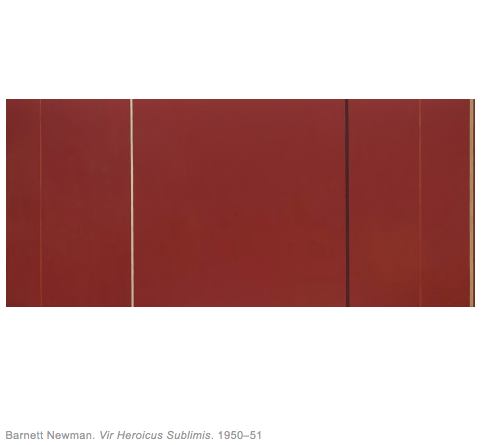
The work by Newman Barnett above is constructed of vertical sections of colour which are zipped together. Barnett encouraged the viewer to stand close to the work to bathe in the colour.
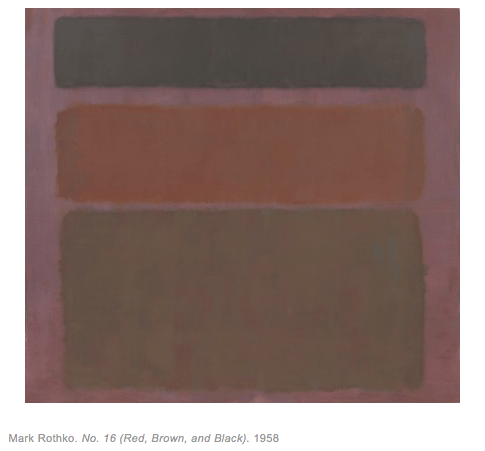
Mark Rothko used colour to elicit a sense of awe and contemplation in his viewers.
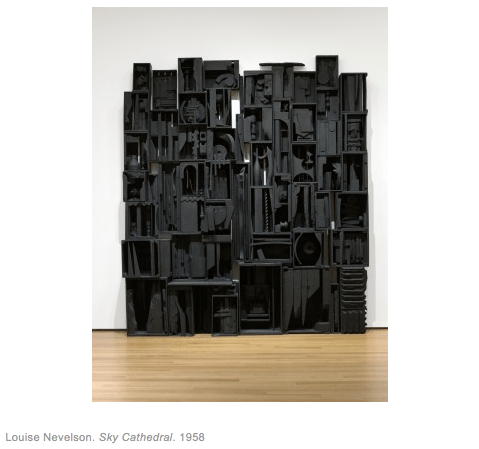
Nevelson, fascinated with the colour black which she stated was “the most aristocratic colour of all”, a colour of acceptance as it contained all colours, created Sky Cathedral to evoke a sense of a shrine and a place of devotion.
Buddhism and Taoism, sublime and impermanence
In both Buddhist and Taoist teachings there is an understanding that life is in continual flux. In Buddhism this is the concept of “Anicca” or “Anitya”, impermanence. In Taoism, it is “the way” or the path, which is fluid and ever changing.
“…in this world there is nothing that is fixed and permanent. Since every thing is subject to change, decay is inherent in all component things, and existence remains forever in a flux, or a continuous becoming, like a flowing river.”
(Hinduwebsite.com, 2020)
Taoism incorporates the concept of Yin and Yang or the duality of existence. Whilst these are seen as opposites, i.e. masculine and feminine, light and dark, day and night etc they are also seen as a continuum of the same thing, just the opposite ends of the spectrum. Within each, is the potential for the other (the opposite ‘dots’ within the symbol). The best description, is in the depths of Winter (Ultimate Yin) the seed (also considered Yin) has the potential for growth and expansion, (Yang) as in a tree which produces leaves, seeds and will eventually die providing nutrients for the next (Yin).
The concept of impermanence or “Anicca” is a cornerstone of Buddhist teachings. Comprehending impermanence is a path to enlightenment and the end to suffering. Otherwise a person with be caught in the never ending “Samsara” (cycle of birth and death) rather than reaching Nirvana (heaven?).
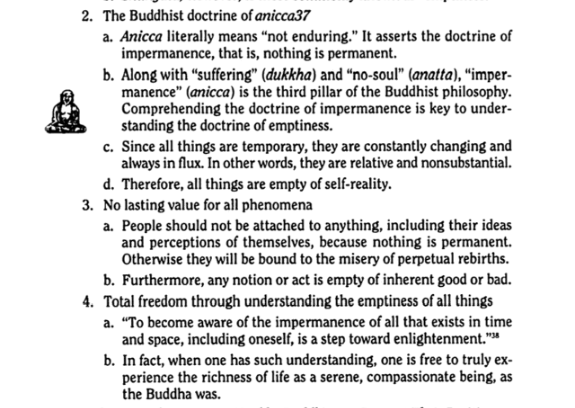
Accepting impermanence can be comforting in times of pain. ‘All things must end’, however not so much in times of pleasure or imagining the loss of a loved one. Perhaps there is something of Burke’s sublime ‘terror’ in the idea of loss, suffering and pain. The Buddhist solution is complete acceptance of these states. To detach oneself completely is to find enlightenment. In some ways we can relate this idea to the Kantian idea of self-transcendence although Kant’s route was through reason rather than detachment.
“Impermanence is inescapable. Everything vanishes.”
(Google Books, 2020)
References and bibliography
- Google Books. (2020). A Philosophical Enquiry Into the Origin of Our Ideas of the Sublime and Beautiful. [online] Available at: https://books.google.co.uk/books/about/A_Philosophical_Enquiry_Into_the_Origin.html?id=Ygi4F1k9KmYC&printsec=frontcover&source=kp_read_button&redir_esc=y#v=onepage&q&f=false [Accessed 6 Jan. 2020].
- Wordsworth Trust. (2020). Edmund Burke and the Sublime – Wordsworth Trust. [online] Available at: https://wordsworth.org.uk/blog/2015/03/02/edmund-burke-and-the-sublime/ [Accessed 6 Jan. 2020].
- Flax.nzdl.org. (2020). In what sense does our experience of the sublime demonstrate the supremacy of our rational nature, according to Kant?. [online] Available at: http://flax.nzdl.org/greenstone3/flax;jsessionid=874EBF5E5FFCD575B271A5254A95CD87?a=d&c=BAWEAH&d=D2607&dt=simple&p.a=b&p.s=ClassifierBrowse [Accessed 7 Jan. 2020].
- Brady, Emily. (2012). “Reassessing Aesthetic Appreciation of Nature in the Kantian Sublime.” Journal of Aesthetic Education, vol. 46, no. 1, 2012, p. 91+. Gale Academic Onefile, https://link-gale-com.ucreative.idm.oclc.org/apps/doc/A530171383/AONE?u=ucca&sid=AONE&xid=56cf0e8e. Accessed 7 Jan. 2020.
- Moma.org. (2020). MoMA | The Sublime and the Spiritual. [online] Available at: https://www.moma.org/learn/moma_learning/themes/abstract-expressionism/the-sublime-and-the-spiritual/ [Accessed 7 Jan. 2020].
- Hinduwebsite.com. (2020). Anicca or Anitya in Buddhism. [online] Available at: https://www.hinduwebsite.com/buddhism/anicca.asp [Accessed 13 Jan. 2020].
- Fischer, N., Fischer, A. and Staff, L. (2020). What Is Impermanence in Buddhism? – Lion’s Roar. [online] Lion’s Roar. Available at: https://www.lionsroar.com/impermanence-is-buddha-nature-embrace-changemay-2012/ [Accessed 13 Jan. 2020].
- Google Books. (2020). Buddhism, Taoism, and Other Far Eastern Religions. [online] Available at: https://books.google.co.uk/books?id=q5cIHa-kIL4C&pg=PA43&lpg=PA43&dq=taoism+impermanence&source=bl&ots=iy2xigCj-L&sig=ACfU3U39T7HwyRlvKJULj9ppXbEIy1Ssmg&hl=en&sa=X&ved=2ahUKEwjrvPzLk4HnAhVQTsAKHaRsAeE4ChDoATACegQIChAB#v=onepage&q=taoism%20impermanence&f=false [Accessed 13 Jan. 2020].
- Encyclopediaofbuddhism.org. (2020). Anitya – Encyclopedia of Buddhism. [online] Available at: https://encyclopediaofbuddhism.org/wiki/Anitya [Accessed 13 Jan. 2020].
- Google Books. (2020). The Best Buddhist Writing 2013. [online] Available at: https://books.google.co.uk/books?id=dZ0QAQAAQBAJ&pg=PT84&lpg=PT84&dq=Melvin+McLeod,+%E2%80%8EEditors+of+the+Shambhala+Sun+-+2013+-+%E2%80%8EReligion&source=bl&ots=hJmSUipCS3&sig=ACfU3U3tlPa3Szl_OI_j-qSIuQ_tkIJwAg&hl=en&sa=X&ved=2ahUKEwjhgI61q4HnAhUKQkEAHS57BS4Q6AEwBnoECAkQAQ#v=onepage&q=Melvin%20McLeod%2C%20%E2%80%8EEditors%20of%20the%20Shambhala%20Sun%20-%202013%20-%20%E2%80%8EReligion&f=false [Accessed 13 Jan. 2020].
 Landscape, Place and Environment