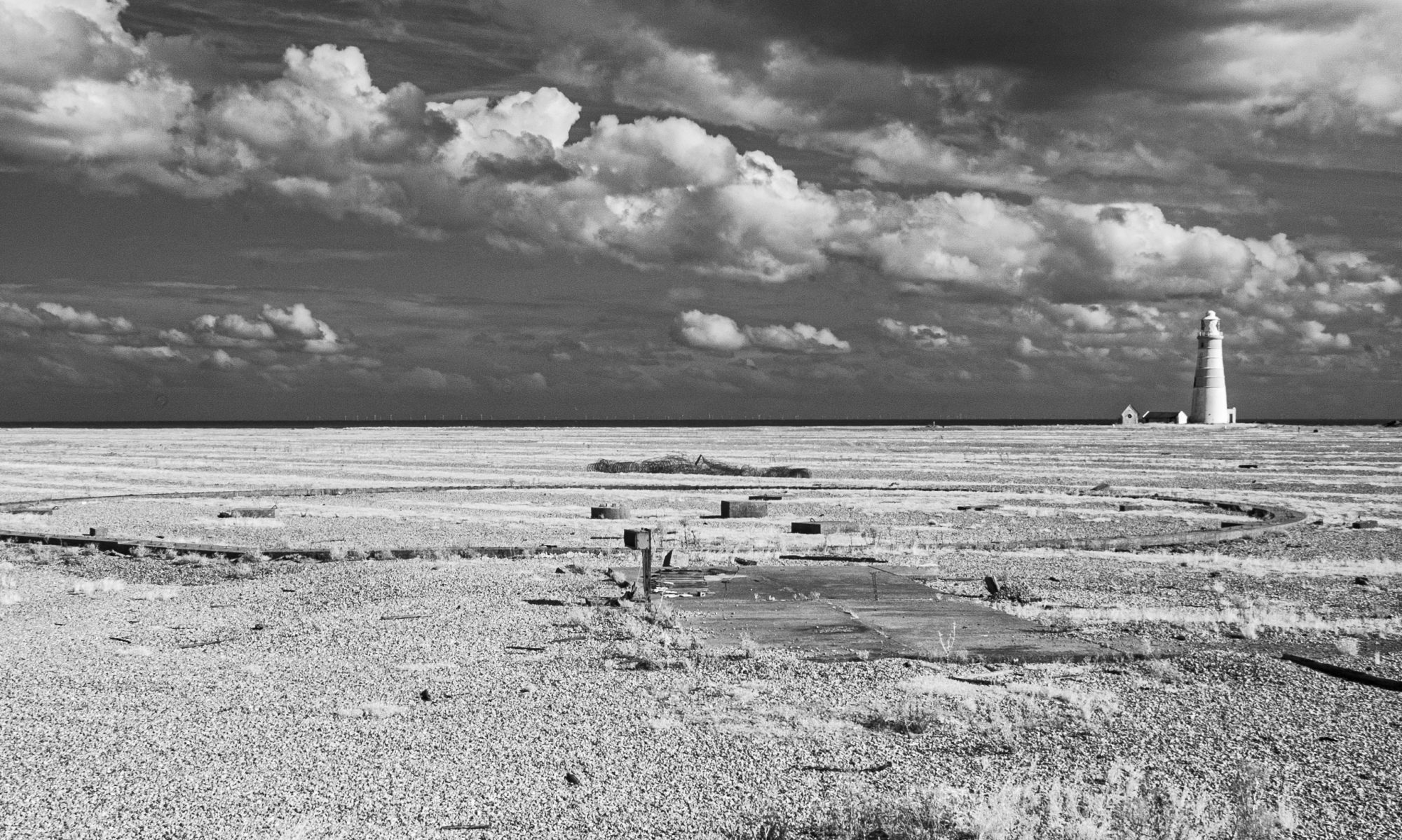
Edmund Burke’s definitions of the sublime are what we always relate back to but as Simon Morley points out, ” the term has a rather archaic ring.” (Tate, 2019). Burke’s definition below:
Whatever is fitted in any sort to excite the idea of pain, and danger, that is to say, whatever is in any sort terrible . . . is a source of the sublime: that is, it is productive of the strongest emotion which the mind is capable of feeling.
(Google Books, 2019)
Burke’s book was published nearly 200 years ago and our interpretation has gone through many incarnations as artists reinterpret and redefine our notions of the sublime in the context of our times.
Burke focuses on the untamed aspect of Nature and the awe and wonder we feel whilst viewing it which is why I’ve chosen to look at the work by Catherine Hyland below. Sublime isn’t what I’d have immediately thought of when viewing the work, if anything I would have said ‘beautiful’ in relation to the soft colour palette and vast mountain landscape. Vastness is probably the operative word here being one of the objects that Burke identified as being “productive of the sublime”. (Alexander, 2015) The vastness of the landscape is what makes our human attempts to ‘tame the landscape’ appear in relation to be small and insignificant.
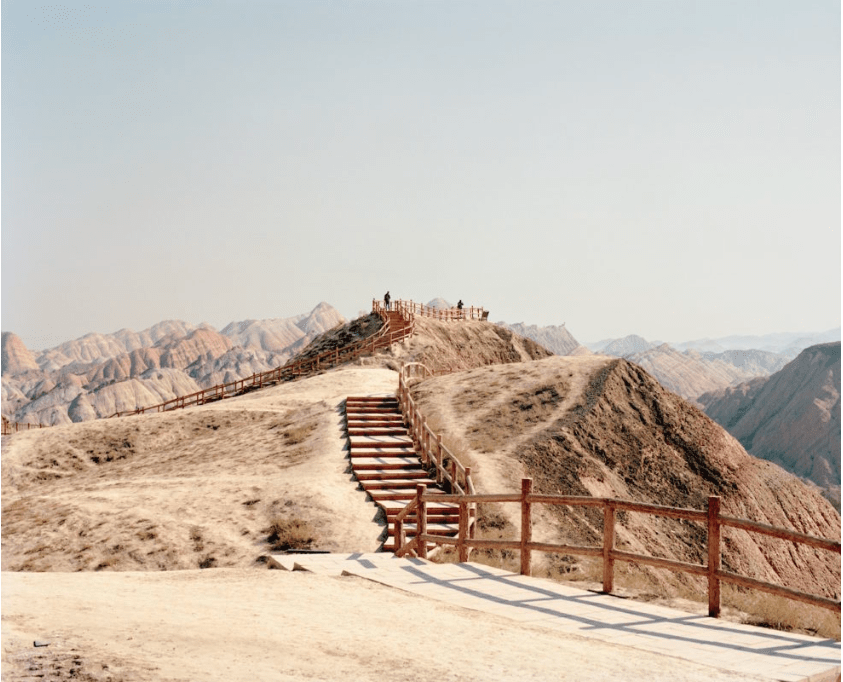
Her other ongoing project, Universal Experience, instead suggests the insignificance of humanity set against the vastness of Chinese and Mongolian landscapes. Her work combines ideas of the sublime, the tourist gaze and collective memory with theories on survey photography and the ways in which we try to control the land around us, placing the natural and the artificial side by side.
(British Journal of Photography, 2019)
The safety rails and convenient steps that are built to protect the visitors seem in some ways inadequate when placed against the backdrop of this dry mountainous region which perhaps should induce a level of terror in it’s visitors. What would happen if you leaned over too far, would you fall into an abyss?
One re-envisages the self as existing in the light of some unnameable revelation arising in a gap between, on the one hand, a dull and alienating reality, and on the other an unmediated awareness of life.
(Tate, 2019)
There is a sense of futility as we imagine the tourists taking their selfies or composing spectacular views to share on social media as if having conquered the landscape. Another link here to the sublime is that of the uncanny. Freud used the term unheimlich which translates to unhomely or out of place. (Alexander, 2015). The presence of the tourists are certainly out of place really however we have come to expect evidence of human presence in much of our landscape.
The human presence and built structures occupy a fraction of the time and space compared to the surrounding mountains. There is a realisation then that despite our efforts Nature remains a force greater and more enduring than ourselves.
- Tate. (2019). Staring into the contemporary abyss: The contemporary sublime – Tate Etc | Tate. [online] Available at: https://www.tate.org.uk/tate-etc/issue-20-autumn-2010/staring-contemporary-abyss [Accessed 16 Dec. 2019].
- British Journal of Photography. (2019). Ones to Watch: Catherine Hyland. [online] Available at: https://www.bjp-online.com/2017/06/ones-to-watch-catherine-hyland/ [Accessed 16 Dec. 2019].
- Google Books. (2019). A Philosophical Enquiry Into the Origin of Our Ideas of the Sublime and Beautiful. [online] Available at: https://books.google.co.uk/books/about/A_Philosophical_Enquiry_Into_the_Origin.html?id=Ygi4F1k9KmYC&printsec=frontcover&source=kp_read_button&redir_esc=y#v=onepage&q&f=false [Accessed 17 Dec. 2019].
- Alexander, J. (2015). Perspectives on place. Bloomsbury, pp. 69-75.
 Landscape, Place and Environment